

If you only have three hours a week to train, compound lifts are the most sensible place to spend them. Compound lifts are multi-joint exercises that move several muscle groups at once, so a single squat, deadlift or press does work that would otherwise take three or four separate isolation exercises. They build strength you can actually use, whether that means carrying shopping, climbing stairs without getting winded, or picking up a child without straining your back.
The point is not to lift the heaviest weight in the gym. It is to train movement patterns — squatting, hinging, pushing and pulling — under a load you can control. Done well, compound lifts improve muscle mass, bone density, balance and everyday stamina at the same time. The Mayo Clinic strength-training guide recommends strength training for all major muscle groups at least twice a week, and compound movements make that target realistic for busy people because each exercise covers so much ground.
What Are Compound Lifts?
A compound lift crosses more than one joint and recruits a chain of muscles to complete the movement. In a squat, your ankles, knees and hips all move while your quadriceps, glutes, hamstrings, calves and core work together. In a bench press, your shoulders and elbows move while your chest, triceps and front shoulders share the load. An isolation exercise, by contrast, targets one joint and usually one muscle: a bicep curl bends only the elbow, and a leg extension bends only the knee.
Neither type is bad, and isolation work has a place for rehabilitation or bringing up a weak muscle. But if strength and general fitness are the goal, compound lifts should come first in a session, when you are freshest and can handle the most weight safely. Isolation exercises work best afterwards, as finishing work, not as the main event. A good rule is to spend about 80 percent of your training time on compound movements and 20 percent on isolation work.
Compound lifts also teach coordination. Your body has to brace, balance and produce force in a sequence, which is why they transfer so well to sport and daily life. A leg press can build strong legs, but it does not teach you to keep your trunk rigid while your hips and knees move together, as a squat does. That skill is what protects your back when you lift a suitcase or move furniture.
The Big Five Compound Lifts
Most beginner programmes are built around five lifts. Together they cover the lower body, upper-body push, upper-body pull and the posterior chain — the muscles down the back of the body that matter most for posture and back health.
1. Squat
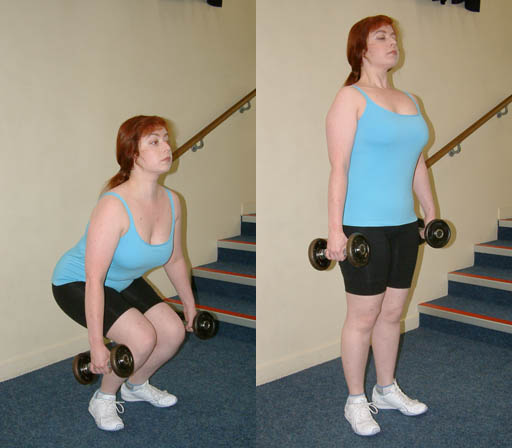
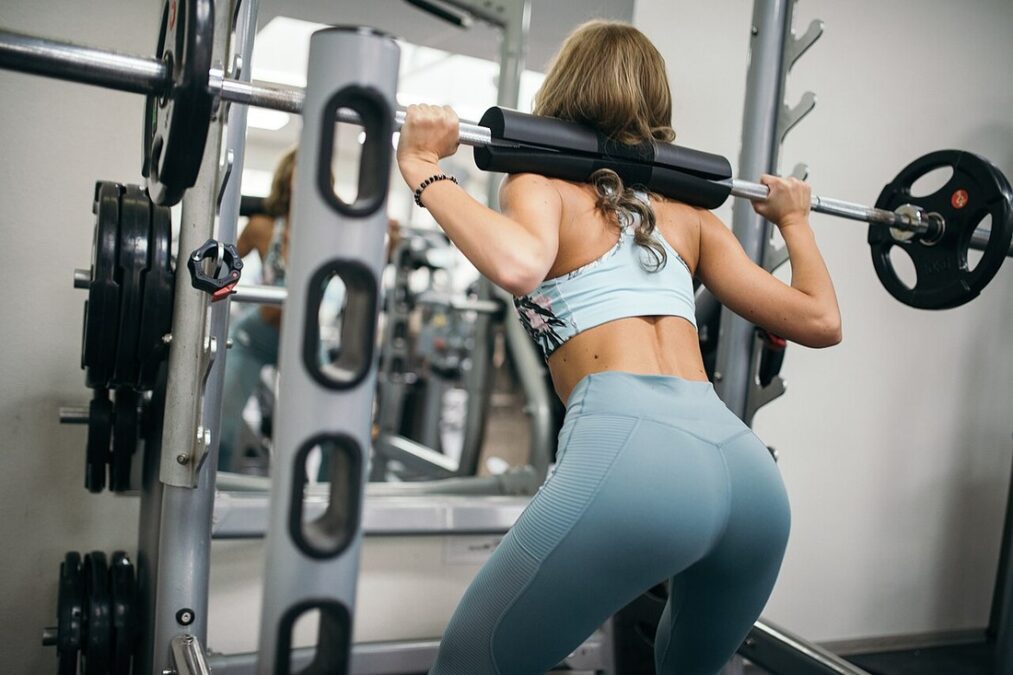
The squat is the foundation lower-body lift. Stand with your feet about shoulder-width apart, toes turned out slightly, and the bar resting across your upper back rather than on your neck. Take a deep breath, brace your stomach as if someone were about to poke it, then sit down between your hips, pushing your knees out in line with your toes. Aim to get your hips at least to knee height, or lower if your mobility allows, then drive up through your whole foot.
The most common faults are letting the knees cave inward, lifting the heels off the floor, and collapsing the chest forward. Think “knees out, chest proud, feet flat” and film yourself from the side every few weeks. Most beginners do well with three sets of five repetitions, resting two to three minutes between sets, using a weight that leaves one or two good repetitions in reserve.
2. Deadlift
The deadlift is a hip hinge, not a squat with the bar in your hands. Stand with the bar over the middle of your feet, shins close to the bar, and grip just outside your legs. Push your hips back, take the slack out of the bar, then drive the floor away while keeping the bar dragged up your shins and thighs. Stand tall without leaning back at the top, then reverse the movement with control.
Keep your back flat and your lats tight throughout. If the bar drifts forward, your lower back will take over, which is where most deadlift injuries come from. Because the deadlift is so demanding, beginners usually need only one or two hard sets of five repetitions per session. That is enough to progress, and it leaves room to recover for the next workout.
3. Bench Press
Lie on the bench with your eyes under the bar, feet flat on the floor, and shoulder blades squeezed together. Unrack the bar, lower it under control to the middle of your chest with your elbows at roughly 45 to 75 degrees from your torso, pause briefly, then press it back up in a slight arc toward your shoulders. A moderate arch in your upper back is normal; your glutes should stay on the bench.
Do not bounce the bar off your chest or flare your elbows to 90 degrees, both of which stress the shoulders. Use a spotter or safety bars when you train heavy, and do not sacrifice range of motion for extra weight. Three sets of five repetitions is a solid starting point, with two to three minutes of rest between sets.
4. Overhead Press
The overhead press builds shoulder and upper-back strength and teaches full-body bracing like no other upper-body lift. Stand with the bar at your upper chest, forearms vertical, elbows slightly in front of the bar, and glutes and stomach braced. Press the bar straight up, moving your head back just enough for it to pass, then push your head through at the top so the bar finishes over the middle of your feet.
This lift progresses slowly because the muscles involved are relatively small, so add weight in small steps — 1 to 2.5 kilograms at a time — and expect plateaus. Three sets of five repetitions works well, and strict form matters more here than in any other lift: no leaning back into a standing bench press, and no bouncing the bar off your chest.
5. Barbell Row
Every programme needs a pull to balance all the pressing, and the barbell row is the most direct option. Hinge forward until your torso is roughly 45 degrees to the floor, brace your core, and pull the bar to your lower ribs or upper stomach. Your elbows should track back, not flare straight out, and your torso should stay still rather than heaving up and down.
Rows strengthen the upper back, rear shoulders, biceps and grip, and they help counter the rounded-shoulder posture that comes from sitting at a desk. Three sets of five to eight repetitions is a good range. If your lower back gets tired from deadlifts and squats in the same session, a chest-supported row or a one-arm dumbbell row is a sensible swap.
Why Compound Lifts Work So Well
First, they are efficient. Five lifts can train your whole body in three sessions of 45 to 60 minutes a week, which is far easier to sustain than a six-day split built around single-muscle exercises. Second, they let you use heavier weights, and heavier weights are what drive strength gains. A 60-kilogram squat simply demands more from your body than a 10-kilogram leg extension ever will.
Third, compound lifts load your bones as well as your muscles. Resistance training is one of the few forms of exercise consistently linked with better bone mineral density, which matters increasingly after the age of 40. Fourth, they improve balance and coordination, because you must stabilise a free weight rather than following a fixed machine path. For older adults, that combination of strength and balance is directly linked to staying independent and reducing falls.
There is also a practical benefit: progress is easy to measure. When your squat goes from 40 kilograms for five repetitions to 60 kilograms for five, you know you are stronger. That clear feedback keeps people training long after the novelty of a new routine has worn off.
A Sample Beginner Programme
This three-day routine alternates two workouts. Train on non-consecutive days, for example Monday, Wednesday and Friday, and alternate Workout A and Workout B each session. Warm up for five minutes, then do two or three warm-up sets with the empty bar and light weights before your working sets.
Workout A: squat 3 sets of 5, bench press 3 sets of 5, barbell row 3 sets of 5 to 8. Workout B: squat 3 sets of 5, overhead press 3 sets of 5, deadlift 1 to 2 sets of 5. Finish each session with a short core exercise, such as a plank or a dead bug, and a few minutes of easy walking or stretching.
Start with a weight you can lift with good form for all sets, even if it feels light. Add 2.5 kilograms to upper-body lifts and 5 kilograms to lower-body lifts each session while form holds. When that stops working, add weight once a week instead of every session, or repeat the same weight until all sets feel solid. On days when you want extra upper-body volume without another barbell session, this upper-body dumbbell workout makes a useful complement, because dumbbells let each arm work independently and are gentler on sore shoulders.
Safety and Progression
Technique comes before weight, every time. A useful test is to ask whether you could do one more clean repetition at the end of a set. If the answer is no and your form is breaking down, the weight is too heavy. Film your main sets occasionally, train with a coach for at least one session if you can, and treat pain as a signal to stop, not a badge of honour. Muscle soreness the next day is normal; sharp joint pain, tingling or pain that changes how you walk is not.
Warm up properly. Five minutes of light cardio, a few dynamic stretches, and ramp-up sets on the lift itself will do more than static stretching before training. Use safety bars in a power rack for squats and bench press, use collars on the bar, and never clip your fingers between plates. If you train alone, learn how to bail safely from a squat and use a spotter or rack for heavy bench press attempts.
Recovery is part of the programme, not an optional extra. Aim for seven to nine hours of sleep, eat enough protein — most active adults do well on roughly 1.6 to 2.2 grams per kilogram of body weight per day — and eat enough overall to support training. If you stall on a lift for two or three sessions in a row, reduce that lift by about 10 percent, rebuild with perfect form, and you will usually pass your old best within a few weeks. Progress in strength is rarely a straight line; a deload week every eight to twelve weeks keeps training sustainable.
Common Mistakes to Avoid
The most frequent errors are easy to fix once you spot them. Rounding the lower back in the deadlift, letting knees collapse in the squat, bouncing the bench press off the chest, and turning the overhead press into a backbend all come from using too much weight too soon. So does skipping warm-up sets. Another common mistake is programme-hopping: changing exercises every week because progress feels slow. Stick with the same five lifts for at least eight to twelve weeks, track every session in a notebook or app, and judge the programme by your numbers, not by how exciting it feels.
Finally, do not neglect pulling work. Many lifters press far more than they row, which tightens the chest, rounds the shoulders and sets up shoulder problems. Keep your total pulling volume at least equal to your pressing volume, and include the row in every week of training.
Frequently Asked Questions
How often should beginners do compound lifts?
Three full-body sessions a week is ideal for most beginners, with at least one rest day between sessions. That frequency gives enough practice to learn the movements and enough recovery to add weight regularly, without taking over your week.
Can beginners safely do compound lifts?
Yes, provided they start light, learn the technique first and progress gradually. Beginners often make the fastest progress of all, because the nervous system learns the movements quickly. A coach, an experienced training partner or video feedback can make the first month much safer and more effective.
Do I need a barbell to do compound lifts?
A barbell is the best tool for progressive loading, because you can add small increments over time. Dumbbells, kettlebells and bodyweight variations such as goblet squats and push-ups can teach the same patterns, and they are a good starting point at home, but a barbell makes long-term progression simpler.
Are compound lifts enough on their own?
For general strength and fitness, the big five cover almost everything, especially when paired with some core work and regular walking or cardio. Competitive athletes and people with specific goals may add isolation work, but most people will get stronger, leaner and more capable on compound lifts alone for their first year or more.
How long does it take to see results from compound lifts?
Most beginners notice better coordination and less soreness within two to three weeks, and measurable strength gains within four to eight weeks. Visible muscle changes usually take eight to twelve weeks of consistent training and adequate protein and sleep, so patience and consistency matter more than any single workout.
Conclusion
Compound lifts are not a shortcut, and they are not only for athletes or powerlifters. They are simply the most direct way to build strength that carries over into real life: a stronger back for lifting, stronger legs for stairs and sport, and shoulders and arms that can push, pull and carry without complaint. Start light, practise the five movements, add weight in small steps, and give the programme at least twelve weeks before you judge it.
Try the beginner routine above for the next eight weeks, write down every weight you lift, and see how much stronger you feel by the end of it. If this guide helped you, share it with someone who is starting out, and come back when you are ready to learn about intermediate programming and accessory work.
This article is for general information only and is not medical advice; consult a qualified healthcare professional before starting a new exercise programme.
