

Most of us know we should eat more fibre, yet very few of us actually do. In the UK, adults eat an average of just 20 grams of fibre a day, well below the recommended 30 grams, and in the United States the average is even lower, at around 15 grams. That shortfall matters more than most people realise, because fibre does far more than keep digestion regular. It feeds the gut microbiome, steadies blood sugar, helps lower cholesterol and keeps you feeling full for longer after a meal.
The good news is that eating more fibre does not require a dramatic diet overhaul or expensive supplements. The foods high in fiber are ordinary, affordable foods you probably already buy: beans, lentils, oats, berries, apples, broccoli, nuts and seeds. According to the Harvard T.H. Chan School of Public Health, fibre is a type of carbohydrate the body cannot digest, and it is found only in plant foods, which is why a diet built around whole plants is naturally a high-fibre diet. This guide explains what fibre does, how much you need, and lists 25 of the best high-fibre foods with the amount of fibre in a typical serving, so you can build better meals starting today.
What Is Fiber and Why Does It Matter?
Dietary fibre is the part of plant foods that your small intestine cannot break down. Instead of being absorbed like other carbohydrates, it passes through to the large intestine, where it is partly fermented by gut bacteria or adds bulk to the stool. Nutritionists divide fibre into two main types. Soluble fibre dissolves in water and forms a gel-like substance; it is found in oats, barley, beans, lentils, apples and citrus fruit, and it helps lower blood cholesterol and slow the rise in blood sugar after eating. Insoluble fibre does not dissolve; it is found in whole wheat, bran, vegetables and the skins of fruit, and it adds bulk and helps food move through the digestive system.
Most plant foods contain a mixture of both types, which is why variety matters more than chasing one single type. A large body of research links higher fibre intake with a lower risk of heart disease, type 2 diabetes, colorectal cancer and constipation. One widely cited analysis of nearly 250 studies found that people eating the most fibre had a 15 to 30 percent lower risk of dying from heart disease and of developing type 2 diabetes than people eating the least. Fibre also supports weight management in a very practical way: high-fibre foods take longer to chew, occupy more space in the stomach and slow digestion, so a 400-calorie bowl of lentil soup keeps you satisfied far longer than a 400-calorie pastry.
How Much Fiber Do You Need Each Day?
Recommendations differ slightly by country, but they all point in the same direction: most of us need roughly a third more fibre than we currently eat. In the UK, the Scientific Advisory Committee on Nutrition recommends 30 grams of fibre a day for adults aged 17 and over. Children need less, from around 15 grams a day for 2 to 5 year olds up to 25 grams for 11 to 16 year olds. In the United States, the Dietary Guidelines recommend 25 to 28 grams a day for adult women and 31 to 38 grams a day for adult men, depending on age and calorie intake. For most adults, a realistic and useful target is 30 grams a day, and the best way to reach it is to add fibre gradually, a few grams at a time, while drinking enough water.
It helps to think in terms of food rather than grams. A day that reaches 30 grams might look like this: porridge made with oats and topped with raspberries at breakfast, a lentil soup with wholemeal bread at lunch, an apple and a handful of almonds as a snack, and a dinner of chickpea curry with brown rice. Each of those foods contributes between 4 and 15 grams, and the total adds up quickly without any need for fibre supplements. If you currently eat very little fibre, increase your intake over two to three weeks rather than all at once, and aim for 6 to 8 glasses of water a day, because fibre absorbs water as it moves through the gut.
25 Foods High in Fiber
The foods below are ranked by how much fibre they provide in a realistic serving, and the figures are approximate values from standard nutrition data. They are grouped so you can see where fibre hides in each part of your diet, from breakfast grains to evening vegetables. You do not need to eat all 25 every week; picking three or four from each group and rotating them is enough to transform your daily total.
Legumes and Beans
Legumes are the single richest source of fibre in the ordinary diet, and they are also cheap, filling and high in protein. A cup of cooked lentils provides about 15.6 grams of fibre, which is more than half the daily target in one serving, along with around 18 grams of protein and a good supply of iron and folate. Black beans provide about 15 grams per cooked cup, chickpeas about 12.5 grams, kidney beans about 13 grams and split peas about 16 grams. Tinned beans count too: a 200-gram serving of baked beans provides roughly 9 grams, though it is worth choosing lower-sugar varieties. Adding a tin of beans to a stew, a handful of lentils to a soup or chickpeas to a salad is one of the fastest ways to lift a meal from 5 grams of fibre to 15.
- Lentils: about 15.6 grams per cooked cup, plus 18 grams of protein.
- Black beans: about 15 grams per cooked cup.
- Split peas: about 16 grams per cooked cup.
- Kidney beans: about 13 grams per cooked cup.
- Chickpeas: about 12.5 grams per cooked cup.
Whole Grains
Whole grains keep the bran, germ and endosperm of the grain intact, which is where most of the fibre lives. Refining a grain into white flour strips most of it away, which is why white bread provides about 1 gram of fibre per slice while wholemeal bread provides about 2.5 to 3 grams. A 40-gram serving of oats provides about 4 grams of fibre, including beta-glucan, the soluble fibre linked with lower cholesterol; a bowl of porridge with berries can easily reach 8 grams. Cooked barley provides about 6 grams per cup, quinoa about 5 grams per cup, brown rice about 3.5 grams per cup, and wholewheat pasta about 6 grams per cooked cup. Popcorn is a surprisingly strong choice too, with about 3.5 grams in a 3-cup serving, making it one of the highest-fibre snacks you can eat.
- Oats: about 4 grams per 40-gram serving, rich in beta-glucan.
- Barley: about 6 grams per cooked cup.
- Wholewheat pasta: about 6 grams per cooked cup.
- Quinoa: about 5 grams per cooked cup, and a complete protein.
- Brown rice: about 3.5 grams per cooked cup.
Fruits
Fruit provides fibre along with water, vitamins and plant compounds, and the fibre is concentrated in the skin and flesh rather than the juice, which is why eating a whole apple beats drinking apple juice. Raspberries are one of the best fruit choices of all, with about 8 grams of fibre per cup, while blackberries provide about 7.6 grams per cup. A medium pear with the skin on provides about 5.5 grams, a medium apple about 4.4 grams, and a medium banana about 3 grams. Avocado is the outlier: a whole medium avocado provides about 10 grams of fibre along with heart-healthy monounsaturated fats. Dried fruit is concentrated, with a quarter cup of prunes providing about 3 grams, but the sugars are concentrated too, so a small portion goes a long way. A practical rule is to keep fruit whole, keep the skin on when you can, and aim for two or three portions a day.
- Avocado: about 10 grams per medium fruit.
- Raspberries: about 8 grams per cup.
- Blackberries: about 7.6 grams per cup.
- Pear: about 5.5 grams per medium fruit, skin on.
- Apple: about 4.4 grams per medium fruit, skin on.
Vegetables
Vegetables are less concentrated in fibre than beans, but because you eat them in larger amounts, they contribute a large share of the daily total. A cup of cooked broccoli provides about 5 grams of fibre, a cup of Brussels sprouts about 4 grams, and a medium baked sweet potato with the skin on about 4 grams. Artichokes are the standout vegetable, with about 10 grams in a single medium artichoke, while a cup of cooked green peas provides about 8.8 grams. Carrots provide about 3.5 grams per cup, and a cup of cooked cauliflower about 5 grams. The simplest way to use vegetables for fibre is to make them half the plate: a generous serving of two different vegetables at dinner can add 8 to 10 grams without any extra effort, and leaving the skin on potatoes and sweet potatoes keeps roughly a third more fibre in the meal.
- Artichoke: about 10 grams per medium artichoke.
- Green peas: about 8.8 grams per cooked cup.
- Broccoli: about 5 grams per cooked cup.
- Brussels sprouts: about 4 grams per cup.
- Sweet potato: about 4 grams per medium potato, skin on.
Nuts, Seeds and Other High-Fiber Foods
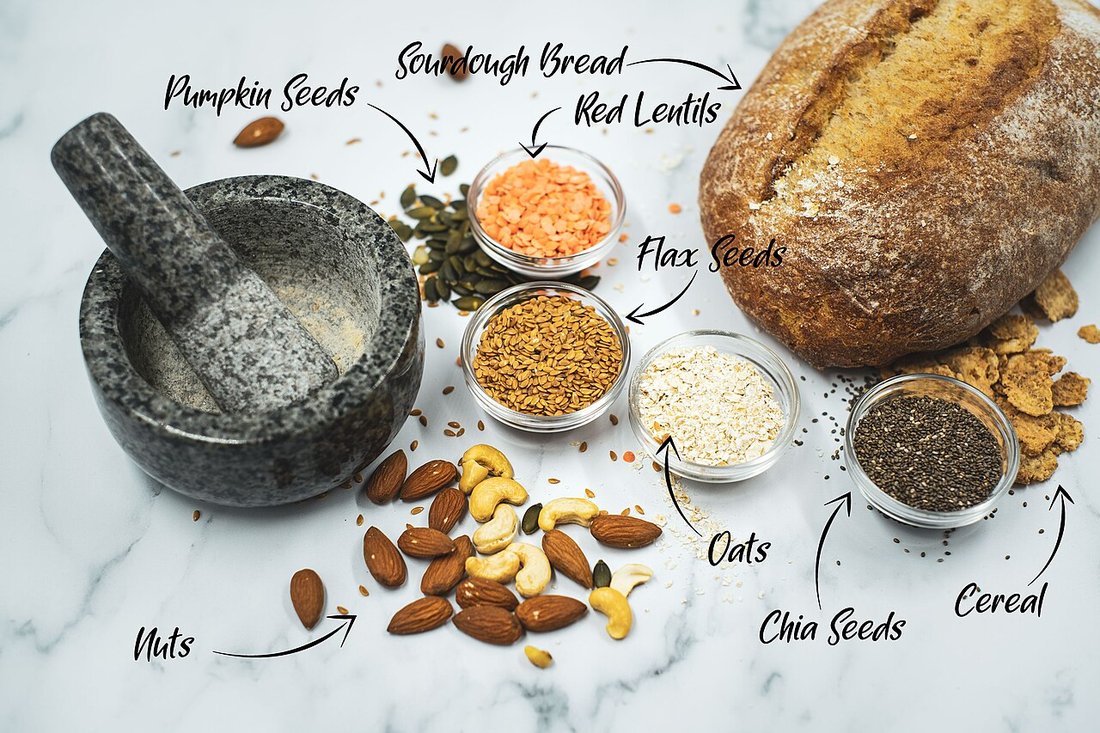
Nuts and seeds are small but dense in fibre, and a small handful adds several grams to breakfast or a snack. Chia seeds provide about 10 grams of fibre per ounce, roughly two tablespoons, and they absorb water to form a gel, which is why they work so well in overnight oats and puddings. Flaxseeds provide about 8 grams per ounce, though they are best eaten ground so the body can absorb their nutrients. Almonds provide about 3.5 grams per ounce, pistachios about 3 grams, and walnuts about 2 grams. A tablespoon of peanut butter provides about 1.6 grams. Because nuts are energy-dense, a portion of about 30 grams, or a small handful, is the right amount for most people. Beyond nuts and seeds, foods such as edamame, with about 8 grams per cooked cup, and hummus, with about 2 grams per two tablespoons, are easy additions that quietly raise the fibre content of a meal.
- Chia seeds: about 10 grams per ounce (two tablespoons).
- Flaxseeds: about 8 grams per ounce, best eaten ground.
- Edamame: about 8 grams per cooked cup.
- Almonds: about 3.5 grams per ounce.
- Pistachios: about 3 grams per ounce.
How to Add More Fiber to Your Diet
The easiest way to reach 30 grams a day is to make one small swap at each meal rather than changing everything at once. At breakfast, swap white toast for wholemeal toast and add berries or a sliced banana to cereal or porridge; that single change can add 5 grams. At lunch, add beans, lentils or chickpeas to a soup, wrap or salad, and choose wholemeal bread. At dinner, swap white rice or pasta for brown rice, quinoa or wholewheat pasta, and make vegetables half the plate. Snacks are a surprisingly good opportunity: an apple with a handful of almonds provides about 8 grams, and popcorn provides about 3.5 grams per 3 cups.
Two habits make the transition comfortable. First, build up over two to three weeks, adding about 5 grams a day each week, so the gut bacteria that ferment fibre have time to adjust. Second, drink water with high-fibre meals, because fibre needs fluid to do its work; without enough water, a sudden increase in fibre can cause bloating and constipation rather than relieving it. It also helps to read food labels: in the UK, a food can be labelled a source of fibre if it contains at least 3 grams per 100 grams, and high in fibre if it contains at least 6 grams per 100 grams. Choosing foods labelled high in fibre for breakfast cereals, breads and snacks makes hitting the target almost automatic.
Fiber and Gut Health: What the Research Says
Fibre is the main food source for the trillions of bacteria that live in the large intestine. When gut bacteria ferment soluble fibre, they produce short-chain fatty acids such as butyrate, which nourish the cells lining the colon, help keep the gut barrier strong and reduce inflammation. Diets rich in diverse plant fibres are consistently linked with a more diverse gut microbiome, and diversity is one of the strongest markers of a healthy gut. A landmark study published in 2018 found that people who ate more than 30 different plant foods a week had a significantly more diverse microbiome than people who ate fewer than 10. That finding explains why variety matters: lentils, oats, berries, broccoli and nuts each feed different bacterial species.
The benefits extend beyond the gut. Soluble fibre from oats and beans binds to bile acids in the intestine, which helps the body remove cholesterol; trials have shown that eating 5 to 10 grams of soluble fibre a day can lower LDL cholesterol by about 5 percent. Fibre also slows the digestion of carbohydrates, which flattens the blood sugar spike after a meal and improves insulin sensitivity over time. This is one reason high-fibre diets are recommended for people with type 2 diabetes and for anyone trying to avoid it. There is even emerging evidence that a high-fibre diet supports mood and brain health through the gut-brain axis, although that research is still at an early stage and should be treated as promising rather than proven.
Common Mistakes When Increasing Fiber
The most common mistake is increasing fibre too quickly. Doubling your intake in a single day often causes gas, bloating and cramps, and many people conclude that fibre disagrees with them when the real problem was the speed of the change. A second mistake is forgetting water: fibre absorbs fluid, so a high-fibre meal with too little water can make constipation worse. A third is relying on fibre supplements or fibre-enriched processed foods instead of real food. Supplements such as psyllium can help some people, but they do not provide the vitamins, minerals and plant compounds that whole foods do, and a fibre bar that contains 10 grams of fibre alongside 15 grams of sugar is a poor trade.
Another mistake is focusing on fibre while ignoring protein and balance at breakfast, which is when many people eat their lowest-fibre meal of the day. A useful fix is to pair a high-fibre base with protein, for example porridge with nuts and seeds or wholemeal toast with eggs, and our guide to high-protein breakfast ideas shows how to build mornings that are both filling and high in fibre. Finally, remember that juice, smoothies made only from strained juice, and refined grains contribute very little fibre, so a glass of orange juice is not a substitute for eating an orange.
Frequently Asked Questions
What food has the highest fiber?
Among everyday foods, legumes are the richest sources: split peas provide about 16 grams per cooked cup, lentils about 15.6 grams and black beans about 15 grams. Among vegetables, artichokes provide about 10 grams each, and among seeds, chia seeds provide about 10 grams per ounce. No single food is best on its own; a mix of beans, whole grains, fruit and vegetables covers both soluble and insoluble fibre.
How can I get 30 grams of fiber a day?
Build each meal around a high-fibre food. A day that reaches 30 grams could include porridge with raspberries at breakfast (about 8 grams), lentil soup with wholemeal bread at lunch (about 18 grams), and a dinner of chickpea curry with brown rice and broccoli (about 12 grams), plus an apple as a snack. Spread the fibre across the day and increase gradually if you currently eat much less.
Is too much fiber bad for you?
Very high intakes, above 50 to 60 grams a day from food, can cause bloating and may reduce the absorption of minerals such as iron, zinc and calcium if the diet is otherwise poor. For most adults, 30 grams a day is the right target, and problems usually come from increasing fibre suddenly rather than from the amount itself. Drink enough water and build up slowly.
Does fiber help you lose weight?
Fibre supports weight loss indirectly: high-fibre foods are usually less energy-dense, take longer to eat and keep you full for longer, so you naturally eat less at the next meal. Studies consistently find that people who eat more fibre tend to weigh less and find it easier to maintain a healthy weight, but fibre works best as part of an overall balanced diet rather than as a standalone fix.
Are bananas high in fiber?
Bananas are a moderate source of fibre, with a medium banana providing about 3 grams. They are a useful everyday choice, and slightly under-ripe bananas also contain resistant starch, a type of fibre that feeds gut bacteria. For a bigger fibre boost, pair a banana with raspberries, oats or a handful of nuts.
Conclusion
Foods high in fiber are not exotic or expensive. Lentils, beans, oats, berries, apples, broccoli, nuts and seeds are available in every supermarket, and adding a few of them to each meal is enough to move from the average intake of about 20 grams a day to the recommended 30 grams. Start with one swap at breakfast, one at lunch and one at dinner, increase gradually, drink plenty of water, and let variety do the work. Your digestion, your heart and your gut bacteria will all notice the difference within a few weeks.
