

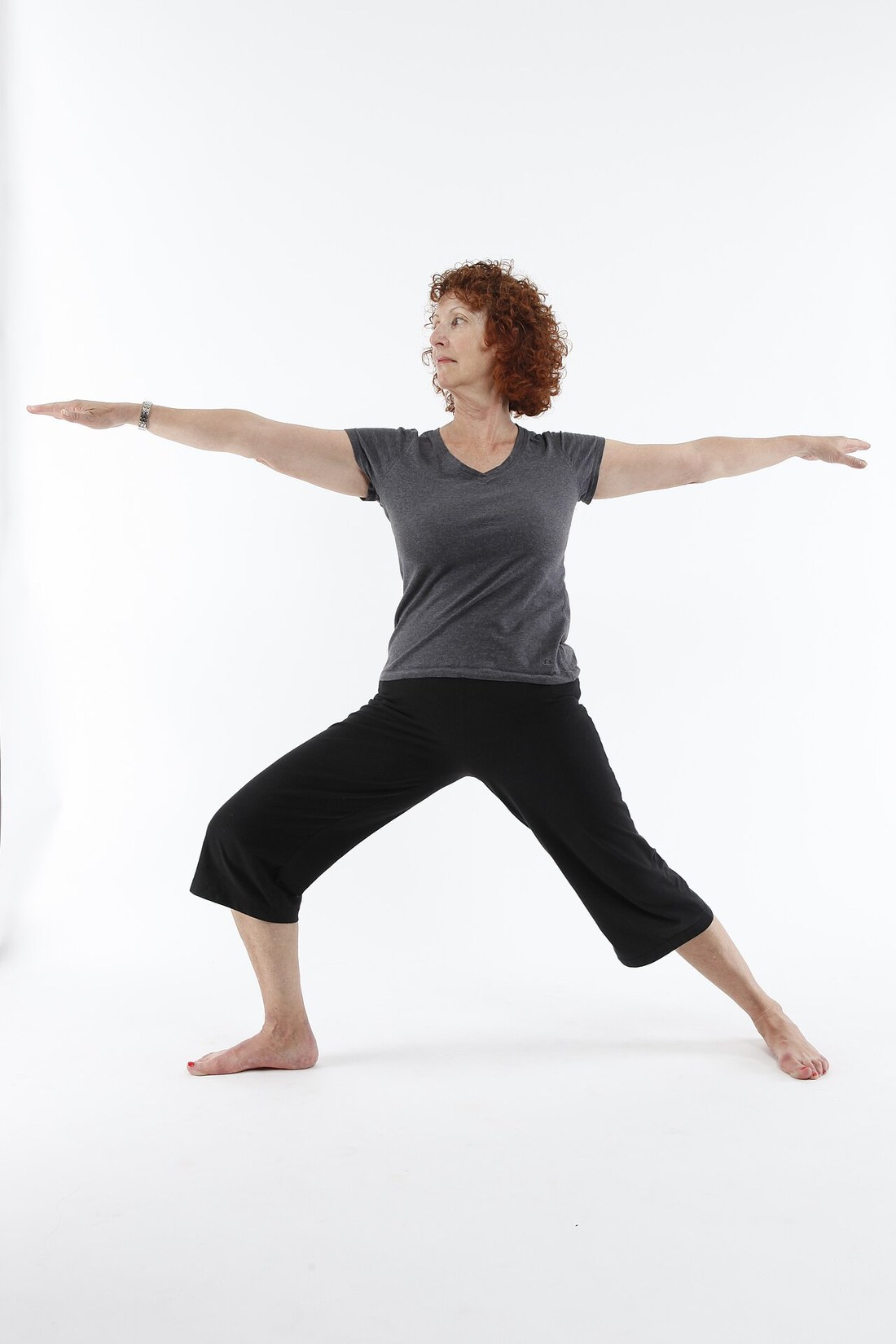
The warrior 2 yoga pose is one of the first standing poses most beginners learn, and for good reason. It is strong, steady, and easy to recognise: legs wide, front knee bent, arms stretched in opposite directions, and gaze fixed calmly over the front hand. In Sanskrit it is called Virabhadrasana II, named after Virabhadra, a fierce warrior figure in Hindu mythology. Despite that dramatic name, the pose itself is accessible. You do not need to be unusually flexible, athletic, or experienced to practise it well, and you can adjust almost every part of it to suit your body.
What makes this pose so useful is that it trains strength and openness at the same time. The front leg works hard, the back leg anchors you, the chest opens, and the arms reach with purpose. It also teaches focus: holding a wide, stable stance while breathing steadily is a practical lesson in staying calm under effort. For a detailed reference with photographs, see Yoga Journal’s Warrior II guide.
What Is Virabhadrasana II?
Virabhadrasana II is the second of three warrior poses in modern yoga. Warrior I faces forward with the hips squared to the front of the mat, while Warrior III balances on one leg. Warrior II is different because the hips and chest open to the long side of the mat. That sideways orientation is what gives the pose its distinctive look and its particular benefits for the hips, inner thighs, and shoulders.
The name is pronounced veer-ah-bah-DRAHS-anna. Virabhadra is often described as a powerful warrior created by the god Shiva, and the pose is said to express courage, steadiness, and determination. You do not need to know the mythology to benefit from the shape, but it helps explain why teachers often cue students to stand tall, breathe evenly, and hold the gaze with quiet confidence rather than straining or rushing.
In most classes, Warrior II is taught as a standing pose that can be held for five to ten breaths, or roughly 30 to 60 seconds on each side. Beginners often start with three to five breaths, then build up as leg strength improves. It appears in many styles, including Hatha, Vinyasa, Iyengar, and Ashtanga-inspired classes, and it is commonly used as a preparation for other standing poses, balancing poses, and seated hip openers.
How to Do Warrior 2: Step-by-Step Alignment
Start in Mountain Pose, standing tall at the centre of your mat with your feet together and your arms by your sides. Step or lightly jump your feet wide apart, about 1.2 to 1.5 metres, depending on your height and leg length. A useful check is that when your arms are stretched out to the sides, your wrists should sit roughly above your ankles. Turn your right foot out 90 degrees so the toes point to the short edge of the mat, and turn your left foot in slightly, about 15 degrees.
- From that wide stance, bend your right knee and move it forward until it sits directly above your right ankle. Aim for a 90-degree angle at the knee if that feels comfortable, with your shin vertical and your thigh approaching parallel to the floor. Do not force the depth; a smaller bend is still Warrior II.
- Press down through the outer edge of your back foot and lift the inner arch slightly. Keep the back leg straight and strong, without locking the knee. Imagine energy travelling down through the back heel and out through the back toes.
- Stack your torso over your pelvis. Lengthen your spine, draw your lower ribs in gently, and avoid leaning forward over the front leg or arching heavily in the lower back. Your shoulders should sit directly above your hips.
- Stretch your arms out to the sides at shoulder height, palms facing down, fingers reaching long. Keep the shoulders relaxed away from your ears. Turn your head to look over your right middle finger, keeping the neck long and the jaw soft.
- Hold for five to ten slow breaths. Breathe in through the nose and out through the nose if you can, and let each exhale help you settle a little deeper without losing the shape. To come out, press into both feet, straighten the front leg, and turn both feet forward before repeating on the left side.
A common alignment check is the front knee. It should track in the same direction as the second and third toes, not collapse inward toward the big toe or drift past the ankle. If you notice the knee wobbling, shorten your stance slightly or reduce the bend until you can keep the knee steady. Stability matters more than depth, especially when you are learning.
Muscles Worked in Warrior 2
Warrior II is often described as a leg pose, but it works the whole body. The front leg’s quadriceps, the large muscles at the front of the thigh, contract to hold the bent-knee position. The gluteus medius and gluteus maximus help stabilise the pelvis and keep the back leg active. The hip flexors, including the psoas and iliacus, work on the front side as the hip flexes, while the adductors of the inner thighs help control the wide stance.
The back leg is not resting. Its quadriceps keep the knee straight, its calf muscles press the foot into the floor, and its gluteal muscles help extend the hip and open the pelvis. At the same time, the muscles around the shoulder blades, including the trapezius and rhomboids, draw the shoulders down and back so the arms can reach without tension creeping into the neck. The deltoids lift and hold the arms, and the core muscles, including the abdominals and the deeper stabilisers around the spine, keep the torso upright.
Flexibility also plays a role. The inner thighs and groin stretch as the legs move apart, the chest opens as the arms extend, and the ankles and feet adapt to a wide, asymmetrical base. That combination is why the pose feels both strengthening and opening, and why many teachers use it early in a standing sequence to wake up the legs before more demanding poses.
Benefits of the Warrior 2 Yoga Pose
Regular, mindful practice can build noticeable leg and hip strength over weeks and months. Holding the pose for 30 to 60 seconds challenges muscular endurance rather than maximum power, which is useful for everyday activities such as climbing stairs, walking on uneven ground, and standing for longer periods. It also improves balance and coordination, because the wide stance requires the feet, ankles, and core to work together to keep you steady.
Warrior II can improve posture by encouraging an upright spine and open chest, a helpful counterbalance to hours spent sitting at a desk or looking at a phone. The hip-opening aspect can ease stiffness in the inner thighs and groin, while the arm position gently stretches the shoulders and upper back. Many practitioners also find the pose mentally grounding. The fixed gaze, known as drishti, gives the mind a single point of focus, which can make it easier to breathe calmly and stay present.
It is also a practical pose for learning body awareness. Because the shape is symmetrical in intention but asymmetrical in the legs, it quickly reveals differences between sides. One hip may feel tighter, one knee may track less cleanly, or one shoulder may lift higher. Noticing those differences without judging them is part of the practice, and it can guide smarter choices about warm-ups, modifications, and rest.
Common Mistakes and How to Fix Them
One of the most common mistakes is letting the front knee collapse inward. Fix it by pressing the knee gently outward, in line with the toes, and by shortening the stance if needed. Another frequent error is leaning the torso forward over the front thigh. Instead, keep the chest lifted and imagine a straight line from the crown of the head down through the pelvis. A third mistake is holding tension in the shoulders. If your shoulders creep toward your ears, lower them, soften the trapezius muscles, and reach through the fingertips rather than forcing the arms up.
Breath holding is another issue. If you notice that you are clenching your jaw or holding your breath, come out of the pose slightly, take two easy breaths, and re-enter with less depth. Yoga should challenge you, but it should not feel like a struggle to survive the hold. Beginners also sometimes step too wide, which makes the pose unstable. A stance that allows a steady knee and a straight back leg is wide enough.
Modifications for Beginners
- Take a shorter stance and bend the front knee only as far as you can while keeping the back heel grounded.
- Practise with your back against a wall for balance, or place a chair nearby for support when stepping in and out.
- Rest your hands on your hips instead of extending the arms if your shoulders are tired or injured.
- Use a folded blanket under the back heel if the heel will not reach the floor comfortably, or shorten the stance.
- Hold for three breaths at first, rest in Mountain Pose, and repeat. Short, steady holds build strength safely.
People with knee, hip, ankle, or shoulder injuries, high blood pressure, or balance conditions should practise cautiously and seek guidance from a qualified teacher. The same applies during pregnancy, when balance and joint stability change. Modifications are not a lesser version of the pose; they are how the pose is made safe and useful for different bodies.
How to Practise Warrior 2 in a Sequence
Warrior II works best after a warm-up. Start with five minutes of gentle movement: neck rolls, shoulder rolls, Cat-Cow, and a few Sun Salutation rounds or marching in place. Then move through Mountain Pose, a wide-legged forward fold, and a low lunge on each side to open the hips and hamstrings. From there, step into Warrior II on the right, hold for five to ten breaths, return to Mountain Pose, and repeat on the left.
After Warrior II, useful follow-on poses include Reverse Warrior, Extended Side Angle, Triangle Pose, and a standing forward fold to release the legs. Finish with a seated forward fold, a gentle twist, and Savasana for at least five minutes. A simple 20-minute home sequence could be: warm-up (5 minutes), Warrior II and Reverse Warrior on each side (8 minutes), Triangle Pose and a forward fold (4 minutes), and rest (3 minutes). Practising two or three times a week is a realistic starting point, and consistency matters more than holding the pose for a very long time on a single day.
For a slower, more restorative complement to this standing work, you can explore yin yoga poses, which use long, supported holds to stretch the hips and spine in a different way. Combining an active standing practice with a gentler session during the week gives many beginners a balanced routine without overloading the same muscles every day.
Frequently Asked Questions About Warrior 2
How long should beginners hold Warrior 2?
Beginners can start with three to five breaths, or about 15 to 30 seconds, on each side. As strength improves, build toward five to ten breaths, or 30 to 60 seconds. Short, stable holds with steady breathing are more useful than a long hold with poor alignment.
Is Warrior 2 good for flexibility?
Yes, especially for the inner thighs, groin, hips, and shoulders. The wide stance gently stretches the adductors, while the open chest and extended arms encourage upper-body mobility. Flexibility improves gradually, so avoid forcing the front knee deeper than your strength can support.
Should my front knee be at 90 degrees?
A 90-degree angle is a common target, not a rule. If your thigh is not yet parallel to the floor, or your back heel lifts when you bend deeper, use a smaller bend. The priorities are a vertical shin, a knee tracking over the toes, and a stable back foot.
Why does my front knee hurt in Warrior 2?
Discomfort often comes from the knee collapsing inward, stepping too wide, or bending too deeply before the supporting muscles are ready. Shorten the stance, reduce the bend, and check that the knee points in the same direction as the toes. Stop and seek professional advice if pain is sharp, sudden, or persistent.
Can I practise Warrior 2 every day?
Many people practise it several times a week as part of a varied routine. Daily practice can be fine if the holds are moderate and you balance it with rest, other poses, and attention to soreness. If your legs feel very fatigued, take a rest day or choose a gentler session instead.
Conclusion
The warrior 2 yoga pose is a clear, practical place to build strength, balance, and focus. It does not require special equipment, and it can be adapted to almost any level by changing the stance, the depth of the bend, and the length of the hold. Practise it slowly, keep the front knee steady, breathe evenly, and let the pose teach you how your body moves from one side to the other.
Try adding Warrior II to your next practice: warm up first, hold each side for five breaths, and finish with a forward fold and a few minutes of rest. Over time, you may notice stronger legs, more open hips, and a steadier sense of focus both on and off the mat.
Disclaimer: This article is for general wellness information only and is not medical advice. If you have an injury, a health condition, or concerns about practising yoga, consult a qualified healthcare professional or experienced yoga teacher before beginning.
