

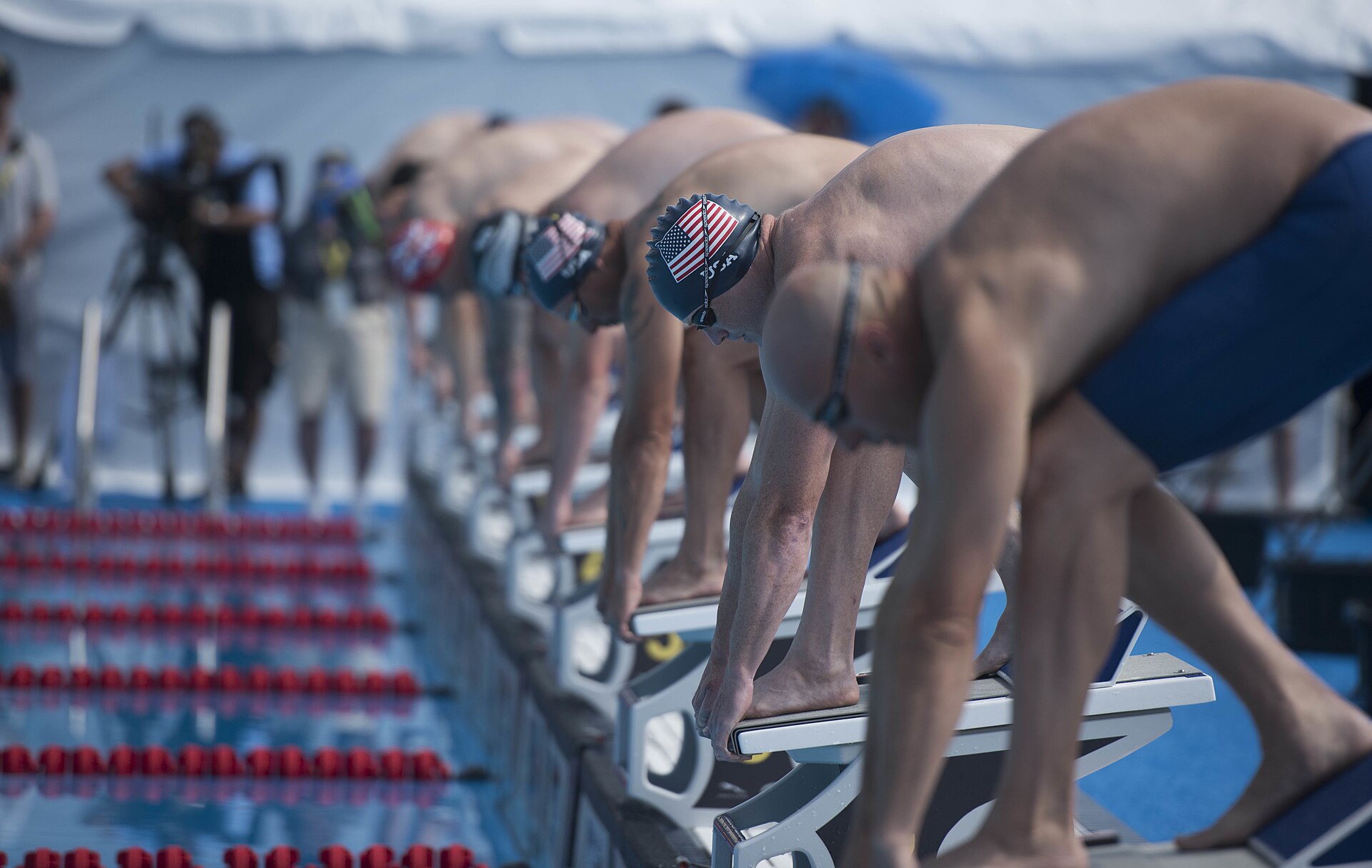
Every competitive swimmer eventually asks the same question: “Am I actually fast?” Swimming motivational times answer it with hard numbers. Published by USA Swimming, these official time standards rank swimmers from beginner to elite across every age group and event. Whether you are a 10-and-under age grouper chasing your first B cut or a high school senior targeting an AAAA standard, motivational times turn vague progress into clear, measurable goals. In this guide, you will learn exactly what swimming motivational times are, how the B-through-AAAA system works, and how to use these benchmarks to train smarter and keep dropping time season after season.
A single personal best tells you that you improved. Motivational times tell you how much that improvement matters. A 32-second 50 freestyle means something very different for a 10-year-old than for a 17-year-old, and comparing your times against the official standards for your age group and course shows you exactly where you stand. Let’s break the whole system down, step by step.
What Are Swimming Motivational Times?
USA Swimming publishes motivational time standards every four years, at the start of each new quad. The standards cover every recognized event — freestyle, backstroke, breaststroke, butterfly, and individual medley — for boys and girls in five age groups: 10 and under, 11–12, 13–14, 15–16, and 17–18. Separate tables exist for short course yards (SCY), short course meters (SCM), and long course meters (LCM), so no matter where or how you race, there is a benchmark for you.
Each standard assigns a letter classification to a swim time: B, BB, A, AA, AAA, or AAAA. Think of B as the starting line and AAAA as the summit. When a swimmer beats the published “A” time for an event, they are said to have an “A” time — or an “A cut” — in that event. Because the standards are national, an A time in California means the same thing as an A time in Florida.
Coaches use these classifications to group swimmers in practice, set season goals, and track long-term development. Some invitational meets even use them for entry, requiring a minimum standard such as a BB time to sign up. For swimmers and parents, though, the greatest value is motivational: every practice and every race gets a concrete target. You can explore the complete official standards on the USA Swimming website.
How the Motivational Time Standards System Works
The system looks intimidating at first, but the logic is simple: the faster the time, the higher the letter. Standards get faster as swimmers age — a time that earns an AAAA at age 10 might only rate a B at 17, which shows just how much athletes develop through their teens. Boys’ and girls’ standards are published separately to reflect physiological differences.
From B to AAAA: What Each Level Means
- B — The starting line. This is roughly where a developing age-group swimmer lands after a season or two of regular training. Getting your first B cut is a genuine milestone worth celebrating.
- BB — A solid, average competitive time. Most year-round club swimmers reach BB in their best events, and many meets use BB as a minimum entry standard.
- A — Above average and genuinely competitive. Swimmers with A times are usually among the faster athletes in their age group locally and often qualify for larger invitational meets.
- AA — A top-level age-group time, the kind that scores points and makes finals at championship meets.
- AAA — Elite territory. Only a small fraction of swimmers in any age group ever reach AAA standards.
- AAAA — The highest motivational classification, approaching national-level performance for the age group. Swimmers here are typically chasing junior national cuts next.
Moving up a single letter usually takes a full season — sometimes more — of focused training. That is exactly why each new cut feels like such an achievement, and why coaches build entire season plans around them.
Short Course Yards vs. Short Course Meters vs. Long Course
In the United States, most club and high school swimming happens in 25-yard pools, known as short course yards (SCY). Short course meters (SCM) uses 25-meter pools, while long course meters (LCM) means a 50-meter, Olympic-size pool. Because short course races include more turns — and every turn is a chance to push off the wall — SCY times run faster than LCM times for the same swimmer.
Always compare apples to apples. A BB time in short course yards is not the same achievement as a BB time in long course meters. When your team switches courses each season, look up the standards for that specific course rather than trying to convert times in your head.
Swimming Motivational Times by Age Group
The table below shows an illustrative example of how standards progress across age groups, using the boys’ 50-yard freestyle (SCY) as the benchmark event. The pattern is what matters here: every step up in age brings significantly faster standards. Treat these numbers as representative examples of the system’s structure, and always verify the current quad’s official figures on USA Swimming’s website before using them for meet entries or records.
| Age Group | B | BB | A | AA | AAA | AAAA |
|---|---|---|---|---|---|---|
| 10 & Under | 37.89 | 34.69 | 31.49 | 29.89 | 28.29 | 26.69 |
| 11–12 | 33.59 | 30.49 | 27.39 | 25.89 | 24.29 | 22.69 |
| 13–14 | 28.99 | 26.19 | 23.39 | 22.09 | 20.79 | 19.49 |
| 15–16 | 26.79 | 24.09 | 21.39 | 20.19 | 18.99 | 17.79 |
| 17–18 | 25.89 | 23.29 | 20.69 | 19.49 | 18.29 | 17.09 |
Notice the climb: the AAAA standard for 17–18 boys is roughly twice as fast as the B standard for 10-and-unders. Girls’ standards follow the same staircase pattern at slightly different values, and every other event — from the 100 backstroke to the 200 butterfly — has its own full set of tables.
Here is how stroke coverage expands as swimmers move through the age groups:
- 10 & under: The focus is on 50s of each stroke — 50 freestyle, 50 backstroke, 50 breaststroke, and 50 butterfly — plus the 100 freestyle and 100 individual medley.
- 11–12: Swimmers add the 100s of every stroke, the 200 freestyle, and the 200 individual medley.
- 13–14: The 200s of each stroke arrive, along with the 400/500 freestyle and the 400 individual medley for developing distance swimmers.
- 15–16: Standards tighten sharply as athletes mature, and the mile (1000/1650 freestyle) becomes a serious event.
- 17–18: Full senior-level event lineups with the fastest standards of the age-group system.
How to Use Motivational Times to Set Goals
Standards only work if you use them. Here is a simple framework that swimmers and parents can follow each season:
- Find your current level. Look up your best times in each event and note the highest letter you have achieved. That is your baseline.
- Chase one letter at a time. If you are a BB swimmer in the 100 freestyle, make “A” the goal — not “AAAA.” Single-step goals keep motivation high and progress visible.
- Turn the gap into process goals. A two-second drop might come from a better start, tighter streamlines, or stronger underwaters rather than simply swimming more laps.
- Re-test every season. Age-group birthdays and course changes (SCY to LCM) reset the targets, so revisit the tables at the start of each season and set fresh goals.
Write the goal down where you will see it — on a water bottle, a bedroom mirror, or a training log. Specific, measurable goals consistently beat vague intentions, and motivational times are about as specific as goals get.
How to Improve Your Swimming Times
Knowing your target letter is half the battle; the other half is the training that earns it. These fundamentals move swimmers up the ladder faster than anything else:
- Fix technique before adding yardage. Water is nearly 800 times denser than air, so reducing drag pays off more than building fitness around a flawed stroke. Working through structured swimming drills for your weakest stroke is the highest-return training you can do.
- Master starts and turns. Races are won and lost at the walls — a powerful start and tight, fast turns can be worth precious tenths in every single race.
- Build your underwaters. Up to 15 meters of each length can legally be swum underwater, where dolphin kicking is faster than surface swimming. Elite age-groupers treat underwaters as a fifth stroke.
- Add dryland strength. Age-appropriate bodyweight work, core training, and mobility build the power that good technique then converts into speed.
- Train consistently. Five focused sessions a week beat sporadic heroic efforts. Aerobic development compounds over seasons, not weeks.
- Race often — and review film. Regular racing teaches pacing and toughness, while video review exposes flaws you cannot feel from inside the water.
None of this works without patience. Jumping from BB to A in a single season is excellent progress; expecting AAAA in a year is a recipe for burnout. Trust the process, and let the standards confirm that it is working.
Motivational Times vs. Championship Cuts
New swim families often confuse motivational times with championship cuts, but they serve different purposes. Motivational times are universal benchmarks that describe how fast you are relative to every age-group swimmer in the country. Championship cuts are entry tickets: the qualifying times set by a specific meet, such as a state championship, sectional meet, or junior nationals.
The two do not map neatly onto each other. A swimmer with AA times might still miss a tough sectional cut, while a swimmer with A times could qualify easily for a state meet with softer standards. Use motivational times for long-term development tracking, and use each meet’s published qualifying times for season planning.
Frequently Asked Questions
Where can I find the official swimming motivational times?
USA Swimming publishes the full standards — every event, age group, and course — on its website, usually as downloadable documents organized by quad (for example, 2025–2028). Your club coach or team website often keeps a copy too.
How often are motivational times updated?
Every four years, at the start of a new quad. Because the swimming population keeps getting faster, standards generally get tougher with each update — an A time from one quad might only be a BB in the next.
What is a good motivational time for a 12-year-old?
It depends on the event, but BB is a strong, realistic goal for most 11–12 swimmers in their best strokes, while reaching A marks a swimmer as genuinely competitive. The healthiest approach is to compare against your own past classifications rather than anyone else’s.
Do motivational times apply to long course meters?
Yes. USA Swimming publishes separate LCM standards because long course racing — with fewer turns in a 50-meter pool — produces slower times. Always check the table that matches the course you are swimming.
Can motivational times be used to enter a swim meet?
Sometimes. Certain invitational meets set their qualifying standards directly from the motivational tables, such as requiring a BB minimum. Most championship meets, however, publish their own cuts. Always read the specific meet information rather than assuming.
Conclusion
Swimming motivational times turn the abstract idea of “getting faster” into a concrete ladder you can climb one letter at a time. Look up the standards for your age group and course, find your current level, and pick the next letter as your target. Then do the unglamorous work — technique, turns, underwaters, and consistency — that earns it.
Your next cut is out there waiting. Talk to your coach, build your season plan around a single-letter jump, and get to work — the clock does not lie, and neither do the standards.
