

Good leg workouts are the foundation of a strong, balanced body. Your legs carry you through every step, stair, run, and jump, yet they are the muscles most people skip. A well-planned leg session builds the quadriceps, hamstrings, glutes, and calves, improves balance, and makes everyday movement feel easier. It also supports better posture, stronger knees, and more power for sport. Whether you train in a busy gym or a small living room, the principles are the same: pick a few proven movements, use good form, and add load gradually.
Many people train their upper body twice as often as their legs, and the imbalance shows up quickly. Weak glutes and hamstrings can change how you walk and squat, while weak calves reduce ankle stability. Strong legs, by contrast, help you lift safely, climb stairs without getting winded, and stay active as you get older. Research on resistance training consistently shows that training a muscle group twice a week, with 10 to 20 hard sets per week for larger muscles, is a practical target for most intermediate lifters. Beginners can start well below that range and still make fast progress.
Why Training Your Legs Matters
The lower body contains some of the largest muscles in the body. The quadriceps group has four muscles, the hamstrings have three, and the gluteus maximus is the largest single muscle in the human body. Because these muscles are large, leg exercises burn a meaningful amount of energy and place a high demand on your heart and lungs. A set of 10 heavy squats will usually leave you breathing harder than a set of 10 biceps curls, and that is a useful sign that the work is doing its job.
Leg strength also protects your joints. Strong quadriceps help control the knee when you step down from a curb or land from a jump. Strong hamstrings and glutes help control the hip and reduce the load that falls on the lower back during lifting. For runners, cyclists, footballers, and hikers, leg strength is not a cosmetic extra. It is the difference between finishing strong and fading in the last 20 minutes. Older adults benefit just as much: leg strength is closely linked to independence, walking speed, and the ability to stand up from a chair without using your hands.
The Best Leg Exercises, With Sets and Reps
You do not need 12 different machines to build strong legs. Five or six well-chosen exercises, done with intent, will cover every major muscle group. Start with a compound movement that uses several joints, then add one or two single-joint movements for the hamstrings and calves. Rest 90 seconds to 3 minutes between sets of heavy compound lifts, and 60 to 90 seconds between sets of lighter isolation work. If you are unsure about technique, check form demonstrations in the ACE Fitness exercise library before you add weight.
1. Back Squat: 3 to 4 sets of 5 to 8 reps
The squat is the most complete leg exercise because it trains the quadriceps, glutes, and core at the same time. Stand with your feet about shoulder-width apart and your toes turned out slightly. Brace your core as if someone is about to tap your stomach, push your hips back, and lower until your thighs are at least parallel to the floor. Drive through your mid-foot to stand, keeping your chest up and your knees tracking in line with your toes. Beginners should start with a goblet squat, holding a dumbbell or kettlebell at chest height for 3 sets of 8 to 12 reps, before moving to a barbell.
2. Romanian Deadlift: 3 sets of 8 to 10 reps
The Romanian deadlift is the best way to load the hamstrings and glutes without the complexity of a full deadlift from the floor. Hold a barbell or two dumbbells in front of your thighs, keep a soft bend in your knees, and push your hips back until you feel a strong stretch in the back of your thighs. Your back should stay flat and the weights should stay close to your legs. Stop when your hips cannot travel farther back without your back rounding, then squeeze your glutes to return to standing. A slow lowering phase of 2 to 3 seconds makes this exercise far more effective than rushing through it.
3. Walking Lunge: 3 sets of 10 to 12 steps per leg
Lunges train each leg separately, which exposes and corrects strength differences between your left and right sides. Take a long step forward, lower your back knee toward the floor, and keep your front knee over your ankle rather than collapsing inward. Push through your front heel to step forward into the next lunge. If walking lunges bother your knees, try a reverse lunge instead: step backward, which usually feels more stable and places less stress on the front knee. Hold dumbbells at your sides when bodyweight lunges become easy for 12 clean reps per leg.
4. Leg Press: 3 to 4 sets of 8 to 12 reps
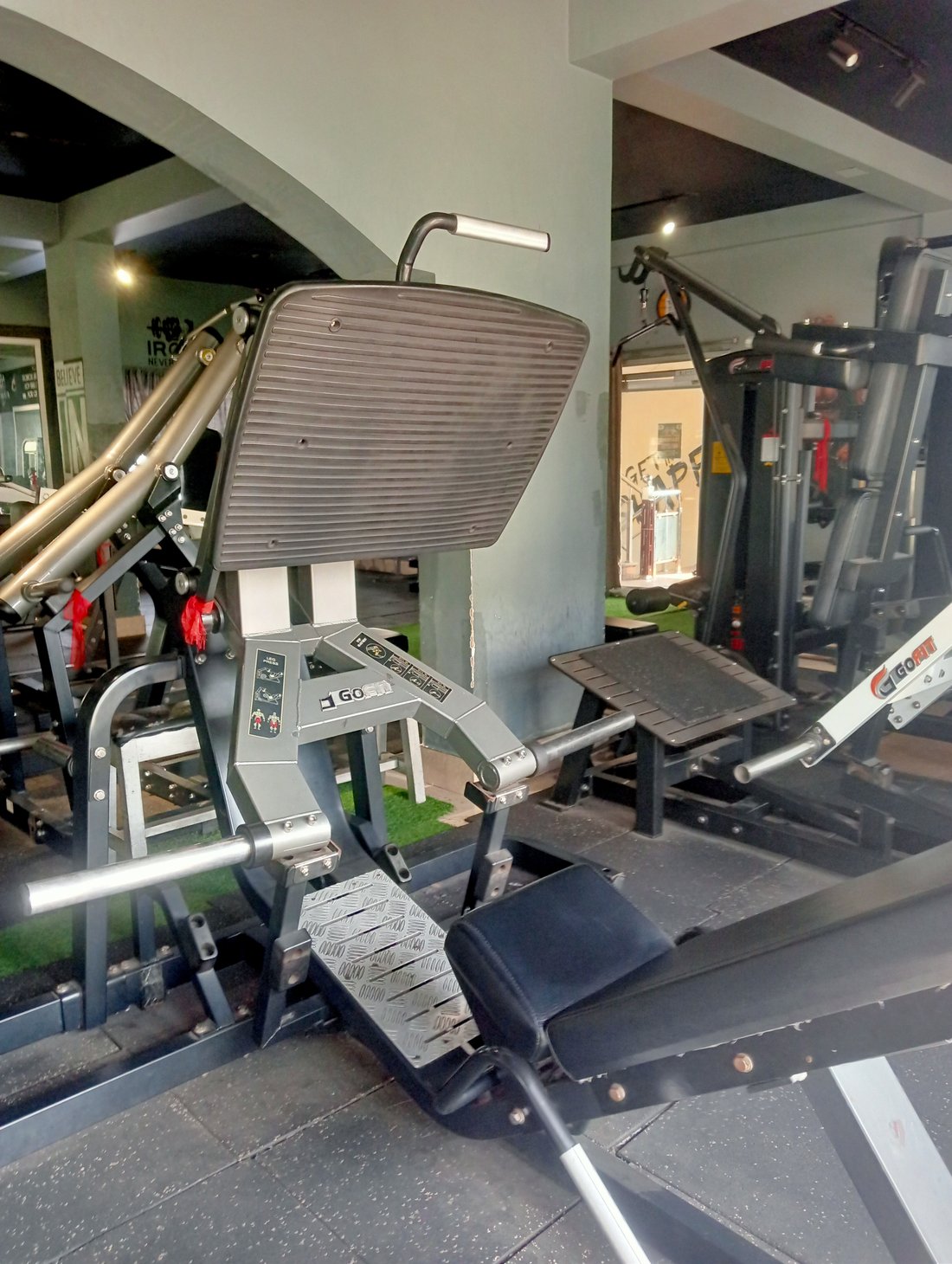
The leg press is useful when you want to load the quadriceps and glutes heavily without balancing a barbell on your back. Sit with your lower back pressed into the pad, place your feet about hip-width apart in the middle of the platform, and lower the weight under control until your knees reach about 90 degrees. Do not let your lower back peel off the pad at the bottom, and do not lock your knees hard at the top. A higher foot position shifts more work to the glutes and hamstrings, while a lower position emphasizes the quadriceps. Use it after squats, not instead of learning to squat, unless a coach has advised you to avoid barbell squats for a specific reason.
5. Hip Thrust: 3 sets of 10 to 12 reps
Hip thrusts are one of the most direct ways to strengthen the glutes, which drive sprinting, jumping, and climbing. Sit on the floor with your upper back against a bench, roll a barbell or dumbbell over your hips, and drive through your heels until your body forms a straight line from shoulders to knees. Pause for one second at the top and squeeze your glutes hard before lowering slowly. Keep your ribs down and avoid arching your lower back to finish the rep. If a barbell feels uncomfortable, a thick pad or a folded towel makes a large difference.
6. Standing Calf Raise: 4 sets of 12 to 15 reps
Calves respond well to full range of motion and a pause at both ends of the rep. Stand on a step or a calf-raise machine, lower your heels as far as comfortable, then rise as high as you can and hold for one second. Many people bounce through calf raises and use only the top half of the movement, which is why their calves stall. Slow the lowering phase to 2 seconds, and add weight once you can complete 15 clean reps. Seated calf raises target the soleus, the deeper calf muscle, so alternating standing and seated variations across the week gives more complete development.
Good Leg Workouts at Home
You can build impressive leg strength at home with bodyweight, a backpack, or a pair of adjustable dumbbells. Bodyweight squats, split squats, step-ups, glute bridges, and single-leg Romanian deadlifts are all highly effective when you control the tempo and train close to failure. A useful home session is: goblet squats 3 sets of 12, Bulgarian split squats 3 sets of 10 per leg, Romanian deadlifts with dumbbells 3 sets of 12, step-ups 3 sets of 10 per leg, and calf raises 4 sets of 15. When 12 reps feel easy, slow the lowering phase to 4 seconds, add a pause at the bottom, or add weight before you add more exercises.
Home training does have limits. It is harder to load a squat heavily without a rack, and progressive overload eventually requires heavier dumbbells, a weighted vest, or resistance bands. Bands are a practical bridge: a heavy loop band around the hips makes glute bridges and squats noticeably harder, and a band anchored low can add resistance to leg extensions and hamstring curls. The key is to keep a simple training log. Write down the exercise, weight, sets, and reps, and aim to beat one number each week. Without that record, it is easy to repeat the same comfortable workout for months.
Good Leg Workouts at the Gym
A gym gives you barbells, a squat rack, a leg press, a leg curl machine, and a calf machine, which makes heavy progressive overload straightforward. A solid gym session is: back squat 4 sets of 6, leg press 3 sets of 10, Romanian deadlift 3 sets of 8, leg curl 3 sets of 12, and standing calf raise 4 sets of 15. That is 17 sets in about 55 to 70 minutes, including warm-up and rest. You do not need to add a sixth or seventh exercise to make it a good workout. In fact, adding too many movements usually means you are not pushing the first few hard enough.
Use machines wisely. They are excellent for training a muscle after your main barbell lift, when your balance and coordination are tired, and for isolating the hamstrings and calves. They are less useful as a complete replacement for free-weight movements, because they remove the balance and core demand that transfers to sport and daily life. A good rule is to start with one free-weight compound lift, follow it with one machine compound lift such as the leg press, and finish with one or two isolation movements.
Warm Up Properly Before Leg Day
A 5- to 10-minute warm-up makes a real difference to both performance and injury risk. Start with 5 minutes of easy cardio, such as cycling, brisk walking, or a rowing machine, until your breathing rises and your legs feel warm. Then do dynamic movements: 10 leg swings per leg in each direction, 10 bodyweight squats, 10 walking lunges, and 10 glute bridges. Finish with 2 warm-up sets of your first exercise, using about 50 percent and then 70 percent of your working weight. Static stretching before heavy lifting can temporarily reduce strength, so save long stretches for after the session or for a separate mobility routine.

A Simple Weekly Leg Split
Training legs twice a week works well for most people. A practical split is: Monday, a heavy leg session built around squats and Romanian deadlifts; Tuesday, upper body; Thursday, a lighter leg session built around lunges, leg press, and hip thrusts; Friday, upper body; and Saturday, optional cardio or sport. That gives each leg muscle about 48 hours between hard sessions, which is enough recovery for most lifters. If you can only train legs once a week, do a single longer session with 14 to 18 total sets and keep the effort high. If you play a sport with running or jumping, reduce leg volume in the week before an important match, because heavy leg training can leave you sore for 48 to 72 hours.
Progressive overload is the rule that ties the split together. Each week, try to add 2.5 kilograms to a barbell lift, add one rep to a set, or add one set to a main exercise. Small increases compound quickly: adding 2.5 kilograms every two weeks to a 60-kilogram squat would take you past 100 kilograms within about eight months, if technique and recovery hold up. That is why a log matters more than motivation. When progress stalls for 3 weeks, change one variable at a time: add a rest day, improve your sleep, eat a little more, or swap a stalled exercise for a close variation for 4 to 6 weeks.
Recovery, Sleep, and Nutrition for Leg Growth
Muscles do not grow during the workout. They grow during the days after it, when your body repairs the small amount of damage caused by training. Sleep is the most underrated recovery tool: most adults need 7 to 9 hours per night, and athletes who sleep less than 7 hours often report worse performance and slower recovery. Soreness is normal after a hard leg session, especially when you try a new exercise, but it should ease within 2 to 3 days. Sharp joint pain, swelling, or pain that changes how you walk is different from soreness, and it is a reason to stop that exercise and seek advice.
Protein and total calories also matter. A widely used target for people building muscle is 1.6 to 2.2 grams of protein per kilogram of body weight per day. For a 70-kilogram person, that is 112 to 154 grams per day, spread across meals that each contain 25 to 40 grams. You do not need expensive supplements to reach that target, although whey protein and creatine monohydrate, at 3 to 5 grams per day, are among the most studied options. Drink water throughout the day, because even mild dehydration can reduce strength and endurance. A small snack with protein and carbohydrates within a couple of hours after training is convenient, but total daily intake matters more than exact timing.
Common Leg Training Mistakes
The most common mistake is cutting squats short. A quarter squat with a heavy weight looks impressive, but it trains a small range of motion and loads the knees without building the glutes and hamstrings through their full length. Lower the weight and use a full, controlled range first. The second mistake is letting your knees collapse inward during squats and lunges. Think about pushing the floor apart with your feet, or use a light loop band around your knees as a reminder during warm-up sets. The third mistake is skipping single-leg work. Bilateral lifts can hide a weaker side, while lunges, split squats, and step-ups force each leg to carry its share.
Finally, do not chase soreness as proof of a good workout. Soreness is highest when an exercise is new, and it fades as your body adapts, even while you are getting stronger. Judge a program by the numbers in your log, how your clothes fit, and how you move in sport and daily life, not by how much you ache the next morning. A deload week every 6 to 8 weeks, with volume cut by about 40 to 50 percent, can also help you recover fully and return stronger.
Frequently Asked Questions About Good Leg Workouts
How often should I train my legs?
Most people do best with 2 leg sessions per week, separated by at least 48 hours. Beginners can start with 1 to 2 sessions, while advanced lifters may use 2 to 3 shorter sessions. Total weekly volume matters more than the exact split, so pick a schedule you can repeat for at least 8 weeks.
How long does it take to see results from leg workouts?
Most beginners notice strength gains within 4 to 6 weeks, largely because the nervous system learns the movements. Visible muscle growth usually takes 8 to 12 weeks of consistent training and enough protein. Take a photo and record your weights at the start, because weekly changes are hard to see in the mirror.
Can I build strong legs without weights?
Yes, especially as a beginner. Bodyweight squats, Bulgarian split squats, step-ups, glute bridges, and single-leg deadlifts can build real strength when you slow the tempo, use full range of motion, and train close to failure. As you get stronger, you will need added resistance, such as dumbbells, bands, or a weighted backpack, to keep progressing.
Should I train legs if my knees hurt?
Mild muscle soreness is different from joint pain. If you have sharp, swelling, locking, or persistent knee pain, stop painful exercises and get the knee assessed before pushing through it. Many people find reverse lunges, step-ups, and leg presses more comfortable than deep barbell squats, but the right choice depends on the cause of the pain.
Is leg day enough cardio?
Leg training raises your heart rate, but it does not replace aerobic exercise. Adults should still aim for about 150 minutes of moderate aerobic activity per week, such as brisk walking, cycling, or swimming, plus 2 days of strength training. A short bike ride after leg day can also help you cool down and reduce stiffness.
Conclusion: Start Simple and Stay Consistent
The best leg workout is not the longest or most complicated one. It is the one you can repeat twice a week, with good form, for months. Start with a squat variation, a hip-hinge movement such as the Romanian deadlift, a single-leg exercise such as a lunge, and a calf raise. Add weight slowly, sleep well, eat enough protein, and keep a training log. Within 8 to 12 weeks, you should notice stronger legs, better balance, and easier movement in everyday life.
For a low-impact way to add extra leg work on a recovery day, read our guide Does Swimming Build Muscle? Science Explained, which explains how the flutter kick and breaststroke kick train the quadriceps, glutes, and calves. Start your next leg session with the warm-up above, pick weights you can control for every rep, and leave one rep in reserve on your first week. Your future self, climbing stairs without thinking about it, will thank you.
Disclaimer: This article provides general fitness information only and is not professional medical advice; consult a qualified health or fitness professional before starting a new exercise program.
