

Ab workout exercises are one of the most practical ways to build a stronger, more stable midsection, and they do not require a gym membership or expensive equipment. A good ab workout trains more than the visible six-pack muscles. It also strengthens the deep core muscles that support your spine, improve posture, and help you move, lift, and twist with less strain. This guide explains which exercises work, how to do them safely, and how to put them into a simple routine you can follow at home.
Before you start, it helps to check your form against a trusted reference. The ACE Fitness Exercise Library offers step-by-step descriptions and photos for many core movements, which is useful if you are unsure how a dead bug, plank, or side plank should look. Use that kind of reference alongside this guide, rather than copying fast, jerky repetitions you see in short social videos.
You do not need to train your abs every day, and you do not need hundreds of crunches to see progress. The best results usually come from a small set of well-chosen exercises, steady progression, and enough recovery between sessions. Below, you will find clear sets, repetitions, and form cues, plus beginner-to-advanced options and a 15-minute sample routine.
What Your Core Actually Does
Your core is a system, not a single muscle. The rectus abdominis runs down the front of your abdomen and creates the familiar six-pack look when body fat is low enough for it to show. Beneath and around it, the transverse abdominis acts like a corset, the internal and external obliques rotate and bend your torso, and the muscles along your spine and hips help keep your pelvis stable. Strong hips and glutes also matter, because they work with your core when you walk, run, squat, and carry loads.
That is why the idea of upper abs versus lower abs can be misleading. The rectus abdominis is one muscle, so a crunch or leg raise cannot completely isolate its top or bottom half. Some movements do emphasize one region more than another, because of how your pelvis and rib cage move, but a balanced program should train flexion, anti-extension, rotation, and side bending. That balance is what protects your back and makes everyday movement feel easier.
Best Ab Exercises: Sets, Reps, and Form Cues
The exercises below cover the main core functions. Start with good form at a controlled tempo, breathe normally, and stop a set when your form breaks down rather than forcing extra repetitions with your hip flexors or lower back doing the work.
Exercises That Emphasize the Upper Abs
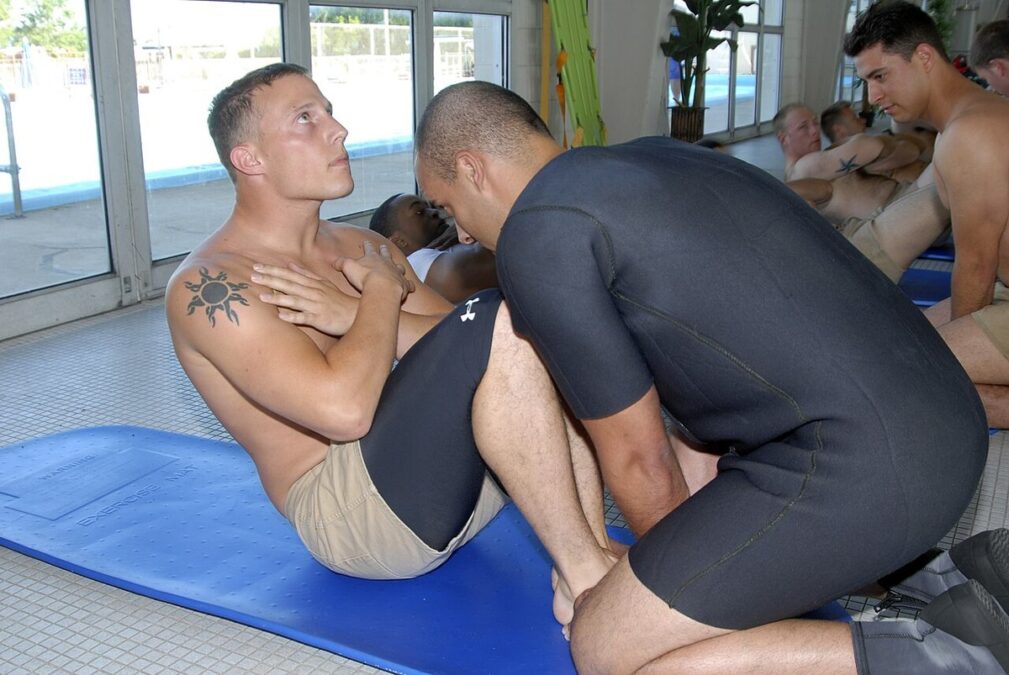
- Crunch: Lie on your back with knees bent and feet flat. Curl your shoulder blades off the floor, exhale at the top, and lower slowly. Do 3 sets of 12 to 15 reps, with 45 to 60 seconds of rest.
- Slow sit-up: Use the same start position, sit up without pulling on your neck, then lower over three seconds. Do 2 to 3 sets of 8 to 12 reps. Keep the movement smooth, not fast.
- Hollow-body hold: Lie on your back, press your lower back into the floor, lift your arms and legs slightly, and hold. Do 3 sets of 20 to 30 seconds. Bend your knees if your back starts to arch.
Exercises That Emphasize the Lower Abs
- Reverse crunch: Lie on your back, bend your knees to 90 degrees, and lift your hips just enough to curl your pelvis toward your ribs. Do 3 sets of 12 to 15 reps.
- Lying leg raise: Keep your lower back pressed into the floor, raise straight or slightly bent legs to about 90 degrees, then lower slowly without letting your back arch. Do 3 sets of 10 to 12 reps.
- Dead bug: Start on your back with arms up and knees at 90 degrees. Extend one arm and the opposite leg, return, and switch sides. Do 3 sets of 8 reps per side, keeping your back flat throughout.
Oblique Exercises
- Side plank: Support yourself on your forearm and the side of your foot, with your body in a straight line. Do 3 sets of 20 to 40 seconds per side. Drop to your knees if your hips sag.
- Bicycle crunch: Bring one elbow toward the opposite knee, extend the other leg, and rotate slowly through your torso. Do 3 sets of 12 reps per side, without pulling your head forward.
- Russian twist: Sit with knees bent and feet on the floor, lean back slightly, and rotate from side to side. Do 3 sets of 12 reps per side. Lift your feet only when you can keep your back straight.
Stability and Deep Core Exercises
- Plank: Hold a forearm plank with your ribs down, glutes engaged, and body in a straight line from head to heels. Do 3 sets of 30 to 60 seconds, with 30 to 45 seconds of rest.
- Bird dog: From hands and knees, extend one arm and the opposite leg, pause, and return without rocking your hips. Do 3 sets of 8 reps per side.
- Band Pallof press: Stand sideways to a resistance band at chest height, hold the band at your chest, and press straight out. Resist rotation for two seconds, then return. Do 3 sets of 10 reps per side.
How to Build a Balanced Ab Workout
A balanced session does not need many exercises. Choose one movement from each group above, so you train flexion, lower-body control, rotation, and stability in the same workout. That usually means four to five exercises, two to three sets each, for a total of 15 to 20 minutes. Rest 30 to 60 seconds between sets, and 60 to 90 seconds between exercises if you are using heavier resistance or longer holds.
Put the hardest stability exercise early, when you are fresh, and finish with a controlled crunch or reverse crunch. Keep the same session for two to three weeks, then add repetitions, time, or resistance before you change the exercises. Tracking your sets makes progression clear: if a plank feels easy at 60 seconds, move to a longer hold, a harder variation, or a weighted version.
Beginner to Advanced Progressions
- Beginner: Knee plank for 20 to 30 seconds, dead bug with feet down between reps, crunch for 10 reps, and side plank from the knees for 15 to 20 seconds per side.
- Intermediate: Full plank for 45 to 60 seconds, bicycle crunch for 12 reps per side, reverse crunch for 12 to 15 reps, and side plank for 30 to 40 seconds per side.
- Advanced: Hollow-body hold for 30 to 45 seconds, hanging leg raise for 8 to 12 reps if you have a secure bar, weighted crunch for 10 to 12 reps, and Pallof press with a stronger band for 10 reps per side.
Move up only when you can complete the easier version with a flat back, steady breathing, and no hip sagging. A harder exercise done poorly is not better than an easier one done well. If a new variation causes sharp pain, go back one step and check your form.
How Often Should You Train Your Abs?
For most people, two to four focused ab sessions per week is enough, with at least one rest day between hard sessions. Your core also works during squats, deadlifts, carries, and many sports, so it does not always need a separate workout every day. Short, low-intensity work such as a brief plank can be done more often, but intense weighted or high-repetition sessions need recovery, just like training for any other muscle group.
Soreness is a useful signal, but it is not the only measure of a good workout. Mild muscle soreness for a day or two can be normal when you try a new movement. Ongoing pain, especially in the lower back or groin, is different. Reduce the range of motion, choose an easier variation, or rest and seek advice if pain persists.
Common Mistakes to Avoid
- Pulling your neck: Keep your hands lightly behind your head during crunches, or cross your arms over your chest, and lift with your ribs, not your hands.
- Letting your back arch: During leg raises and dead bugs, stop the range of motion before your lower back lifts off the floor.
- Rushing reps: Fast, swinging repetitions use momentum instead of muscle. Use a two-second lift, a brief pause, and a two- to three-second lower.
- Training only crunches: Crunches alone miss rotation, side bending, and anti-rotation, which are essential for a stable core.
- Ignoring breathing: Exhale on the effort, inhale as you return, and avoid holding your breath through a whole set.
Sample 15-Minute Ab Routine
This routine uses no equipment and fits into a lunch break or the end of a longer workout. Warm up for two minutes with easy marching and arm circles, then work through the circuit twice, resting 60 seconds between rounds.
- Plank: 40 seconds
- Crunch: 12 reps
- Side plank: 30 seconds per side
- Reverse crunch: 12 reps
- Dead bug: 8 reps per side
- Bicycle crunch: 10 reps per side
If you are just starting out, pair this routine with a broader plan. This beginner workout plan explains how to build a simple four-week schedule around short sessions like this one, so your core work fits into a balanced week rather than becoming a separate chore.
Frequently Asked Questions
How long does it take to see visible abs?
It depends on your starting point, body fat level, training consistency, and nutrition. Strength and stability often improve within four to six weeks, while visible definition can take several months, especially if fat loss is also needed. Visible abs are not the only sign of a strong core.
Can I get abs without changing my diet?
Ab exercises strengthen the muscles, but whether they show depends largely on overall body fat. A balanced diet, enough protein, regular activity, and good sleep support fat loss more reliably than extra crunches alone. Focus on habits you can maintain, rather than a short, extreme diet.
Are crunches bad for your back?
Crunches are not bad for everyone, but they are not right for every back. Keep the range small, avoid pulling your neck, and stop if you feel sharp pain. Planks, dead bugs, and bird dogs are useful alternatives that train the core without repeated spinal flexion.
Should I train my abs every day?
Daily training is not necessary, and it can reduce the quality of your sessions. Two to four focused sessions per week, with rest between hard workouts, is a practical target for most people. If you train daily, keep at least some sessions short and low in intensity.
Do ab exercises burn belly fat?
No exercise burns fat only from one area. Ab training strengthens the muscles underneath, while overall fat loss comes from a sustained calorie deficit, regular movement, strength training, and sleep. Spot reduction is a myth, even though targeted training still has real benefits for strength and posture.
Conclusion
Strong abs come from simple, consistent work, not from a single perfect exercise. Choose four to five movements that cover upper, lower, oblique, and stability training, practice them two to three times per week, and progress slowly. Start with the 15-minute routine above, choose one progression to work toward over the next four weeks, and track your sets, holds, and rest times so you can see real progress.
Disclaimer: This article is for general wellness information only and is not a substitute for professional medical advice. Consult a qualified health professional before starting a new exercise program, especially if you have back pain, a recent injury, or a medical condition.
