

If your shoulders round forward after hours at a desk, your chest feels tight, or you simply want a yoga practice that leaves you feeling lighter and more open, heart chakra yoga poses are a good place to start. These gentle backbends stretch the front of the body, lift the chest and pair movement with slow, steady breathing — a combination many people find both energising and calming. In this guide you will learn what the heart chakra is, how seven classic poses work, and how to practise them safely at home, even if you are new to yoga.
In yoga tradition, the heart chakra — Anahata in Sanskrit — sits at the centre of the chest. It is the fourth of the seven main chakras, the energy centres described in classical yogic texts, and it is linked with love, compassion, forgiveness and connection. Its colour is green, its element is air, and its seed sound is Yam. Yoga Journal’s beginner’s guide to the chakras explains how each chakra is said to relate to a different area of life and the body. Whether you see the chakra system as a literal map of energy or simply as a useful way to choose poses, the physical practice is the same: open the chest, breathe well and move with attention.
What Is the Heart Chakra (Anahata)?
The word Anahata means “unstruck” or “unhurt” in Sanskrit, and the chakra is traditionally pictured as a twelve-petalled lotus at the centre of the chest, roughly level with the heart. In the classical system the seven chakras run from the base of the spine to the crown of the head, and Anahata sits in the middle — between the three lower chakras, which are linked to survival, pleasure and personal power, and the three upper chakras, which are linked to expression, intuition and awareness. That central position is why it is often described as the bridge between the physical and the spiritual, and between how we relate to ourselves and how we relate to other people.
In traditional teaching, the heart chakra governs the heart, lungs, arms and hands, and it is associated with the thymus gland, which plays a role in the immune system. When it is described as balanced, people are said to feel open, generous and able to give and receive love without keeping score. When it is described as blocked or out of balance, the signs people mention are more everyday than mystical: tight shoulders, shallow breathing, difficulty forgiving, or a habit of putting everyone else first. These are traditional ideas rather than medical diagnoses, and they are best treated as a language for noticing how you feel, not as a test you can pass or fail.
Why Heart-Opening Yoga Poses Work
Most of us spend far more time folded forward than we realise: typing, driving, scrolling on a phone. Over months and years that posture shortens the muscles across the chest and the fronts of the shoulders, while the muscles between the shoulder blades grow long and weak. Backbends reverse that pattern. They stretch the pectoral muscles, open the rib cage and strengthen the muscles of the upper back, which is one reason a short heart-opening sequence can make breathing feel easier straight away. The World Health Organization recommends that adults get 150 to 300 minutes of moderate physical activity a week, and a gentle yoga session counts towards that total while also giving the spine movement in a direction it rarely gets during the day.
There is also a calmer, less mechanical side to it. Slow, deep breathing stimulates the vagus nerve, the long nerve that runs from the brain to the chest and belly and helps the body shift out of fight-or-flight mode. Research on yoga and stress has repeatedly linked regular practice with lower self-reported stress and better mood, and many practitioners notice the same thing in a single session: ten slow breaths in a supported backbend can change how the whole day feels. None of this makes yoga a treatment for any condition, but it explains why heart-opening poses are a staple of classes aimed at stress relief.
7 Heart Chakra Yoga Poses to Open Your Heart
Practise these poses in the order given, after five minutes of gentle warm-up such as cat-cow and shoulder rolls. Hold each pose for five slow breaths — roughly 30 to 60 seconds — and move out of any pose that causes sharp pain. You need nothing more than a mat and, for a couple of poses, a block or a folded blanket.
1. Cobra Pose (Bhujangasana)
Lie face down with your legs extended and the tops of your feet on the mat. Place your hands under your shoulders, elbows tucked close to your ribs, and press the tops of your feet and your thighs gently into the floor. On an inhale, lift your chest, keeping your elbows slightly bent and your shoulders well away from your ears. The lift should come from your back muscles, not from pushing hard with your hands — your palms are there for light support. Keep your gaze forward or slightly down, breathe into the front of your chest, and hold for five breaths before lowering slowly. Cobra is the gentlest backbend on this list, which makes it a good first pose and a safe choice if your lower back is sensitive.
2. Fish Pose (Matsyasana)
Lie on your back with your legs extended and your arms by your sides, palms down. Slide your hands under your hips, then press your forearms and elbows into the mat as you lift your chest and arch your upper back. Let the crown of your head rest lightly on the floor, but keep most of your weight in your forearms, not your neck. Your throat and chest should feel open rather than compressed. If the full pose feels too intense, keep your head lifted and rest on your elbows instead — you still get the chest stretch. Hold for five breaths, then tuck your chin, lower your chest and slide out slowly. Fish pose is often used at the end of a practice because it opens the throat and chest together.
3. Bridge Pose (Setu Bandha Sarvangasana)
Lie on your back with your knees bent and your feet flat on the mat, hip-width apart and close enough to your hips that your fingertips can brush your heels. Press into your feet, squeeze your inner thighs gently towards each other, and lift your hips towards the ceiling. Interlace your fingers under your body and press your arms into the mat, or keep your arms by your sides with palms down. Keep your knees pointing straight ahead rather than splaying out, and breathe into your belly and chest for five breaths. Bridge strengthens the glutes and hamstrings while opening the chest, so it earns its place in almost every heart-opening sequence. To come down, lower your spine one vertebra at a time.
4. Camel Pose (Ustrasana)
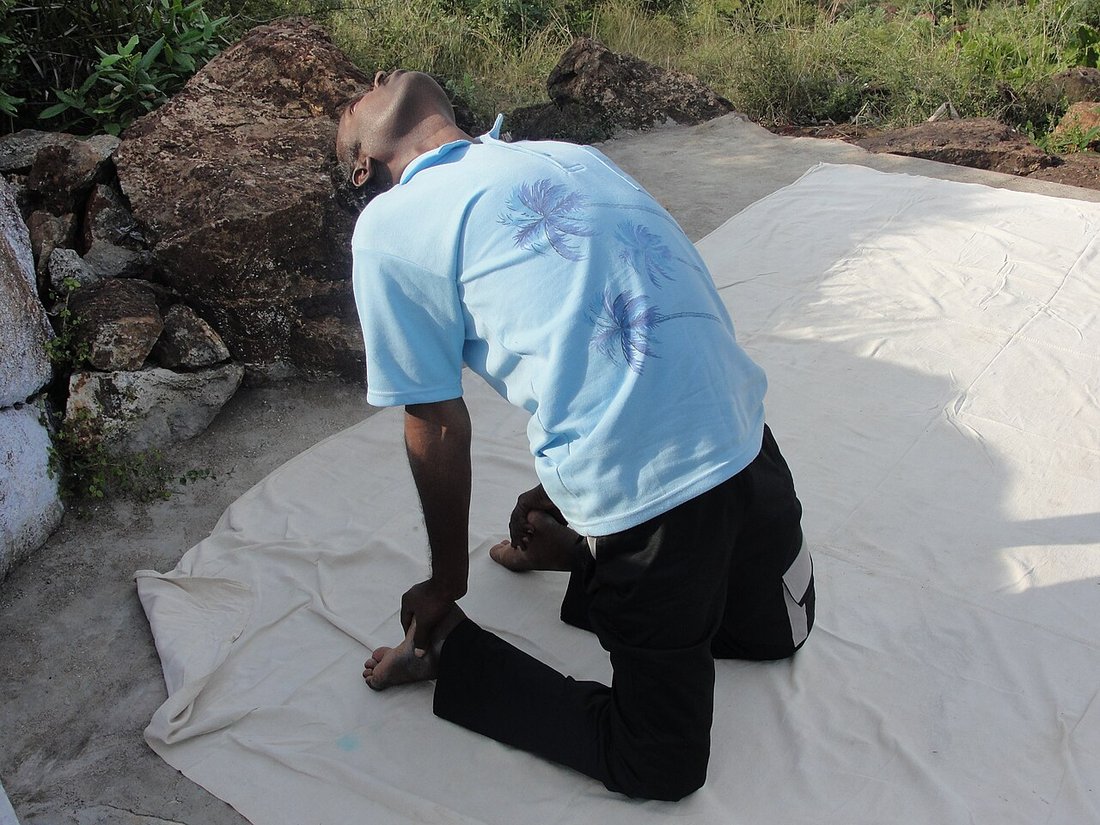
Kneel with your knees hip-width apart and your shins pressing into the mat. Place your hands on your lower back, fingers pointing down, and lift your chest as you gently press your hips forward. If that feels comfortable, reach one hand at a time back to hold your heels, keeping your hips over your knees rather than pushing them backwards. Let your head drop back only if your neck is happy there; otherwise keep your chin slightly tucked. Camel is a deep backbend, so breathe slowly and come out after five breaths by bringing your hands back to your lower back and sitting up with control. If reaching your heels is too much, tuck your toes under to raise the heels, or rest your hands on blocks placed beside your ankles.
5. Bow Pose (Dhanurasana)
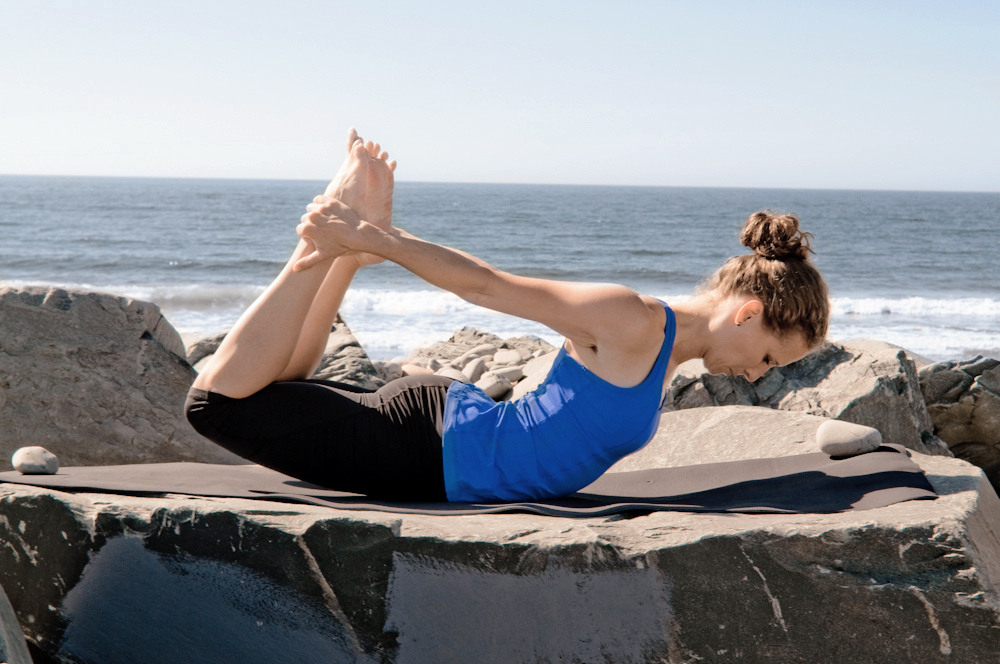
Lie face down and bend your knees so your feet come towards your hips. Reach back and hold the outsides of your ankles, keeping your knees roughly hip-width apart. On an inhale, kick your feet into your hands and lift your chest and thighs off the floor, so your body forms the shape of a bow. Keep your shoulders relaxed and your gaze forward, and breathe steadily — the pose is demanding, so five slow breaths is plenty. Bow pose stretches the whole front of the body, from the thighs and hip flexors to the chest and shoulders, and it asks the back muscles to work hard, which is why it often features in energising morning practices. Lower down slowly and rest your forehead on your hands for a few breaths afterwards.
6. Wheel Pose (Urdhva Dhanurasana)
Lie on your back with your knees bent and feet flat, as for bridge. Place your hands beside your ears, fingers pointing towards your shoulders and elbows pointing up. Press into your hands and feet together to lift your body into a full wheel, straightening your arms and legs as much as you comfortably can. Keep your feet parallel and your weight spread evenly across your hands. Wheel is the most demanding pose on this list: it asks a lot of the wrists, shoulders and lower back, so only practise it if bridge and camel already feel easy, and never push into pain. Hold for three to five breaths, then tuck your chin and lower down slowly. If wheel is not available to you today, a supported bridge with a block under your sacrum gives you a similar chest opening with far less effort.
7. Extended Puppy Pose (Uttana Shishosana)
Start on all fours with your hips over your knees. Walk your hands forward and lower your forehead or chin towards the mat, keeping your hips high and your arms extended. If your forehead does not reach the floor, rest it on a block or a folded blanket. Let your chest melt towards the mat as you breathe, feeling a long stretch through the shoulders and the upper back. Puppy pose is a gentler way to finish than wheel or camel, because the arms take the weight rather than the lower back, and it pairs well with a few slow breaths focused on the centre of the chest. Hold for five to eight breaths, then walk your hands back and sit on your heels.
How to Practise Heart Chakra Yoga Safely
Backbends are rewarding, but they ask for patience. Warm up first — cold muscles and deep backbends do not mix — and build the depth of a pose over several breaths rather than forcing it in one go. Keep the movement smooth: you should be able to breathe normally in every pose, and if your breath becomes ragged or you feel pinching in your lower back, ease off. People with a back injury, a recent surgery, high blood pressure, or a heart or breathing condition should check with a doctor before trying deep backbends such as camel, bow or wheel, and pregnant students should use supported versions and skip poses that compress the belly. Props are not a sign of weakness: a block under the sacrum in bridge, or a bolster under the upper back in fish, often gives you a better stretch than the full pose.
Three habits make the practice safer and more effective. First, strengthen as you stretch: squeeze your glutes in bridge, press your shins down in camel, and use your back muscles rather than your arms in cobra. Second, balance every backbend with a gentle forward fold or twist afterwards, such as child’s pose, so the spine returns to neutral. Third, come out of poses slowly. Dizziness after a deep backbend is common and usually passes in a few breaths, but sit quietly until it does rather than standing up quickly.
Breathing for the Heart Chakra
Breathing is half the practice. Try this before the poses: sit tall, place one hand on the centre of your chest, and breathe in through your nose for a count of four, letting your ribs expand sideways rather than lifting your shoulders. Breathe out for a count of six, feeling your hand fall as your chest softens. After five or six rounds, most people notice their breathing has slowed and their shoulders have dropped without any effort. You can repeat the same slow rhythm inside the poses, using the exhale to soften into the stretch. Some teachers add the seed sound Yam on the exhale, or a simple visualisation of green light at the centre of the chest. Use whatever helps you focus; the breathing itself does the work.
A Simple 15-Minute Heart-Opening Sequence
You do not need an hour to feel the benefit. This short sequence uses the poses above and takes about fifteen minutes, including rest. Start with two minutes of cat-cow to warm the spine, then cobra for one minute and bridge for one minute. Move on to camel for one minute and bow for one minute, resting in child’s pose between the two if you need to. Finish with fish for one minute, puppy pose for two minutes and three minutes lying in savasana, breathing normally. Practise it three times a week and keep a note of how your breathing and posture feel after a month — small, steady practice beats an occasional heroic session. For a slower, floor-based session to pair with this one, try these yin yoga poses on days when your body wants rest rather than effort.
Frequently Asked Questions
How often should I practise heart chakra yoga poses?
Two or three times a week is a good starting point for most people. That is often enough to notice looser shoulders and easier breathing within a few weeks, without overloading the lower back. Daily practice is fine too if you keep the deeper backbends — camel, bow and wheel — to a few sessions a week and use gentler poses such as cobra and puppy pose on the other days.
Can beginners do camel and wheel pose?
Cobra, bridge, fish and puppy pose suit most beginners, because the floor supports you and the depth is easy to control. Camel and wheel are more demanding and suit people who already practise bridge comfortably. Beginners can prepare for camel by practising with blocks beside the ankles, and for wheel by working on bridge and shoulder opening first. There is no rush: the chest opening is the point, not the shape of the pose.
What colour is the heart chakra, and why green?
The heart chakra is traditionally shown as green, the colour of spring leaves and new growth. In the chakra system each centre has a colour, and green is linked with balance, harmony and the natural world. Some teachers also use pink for the heart chakra, associating it with unconditional love. You may notice green used in yoga studios and meditation guides for heart-focused practices, and some people find it a helpful focus for breathing visualisations.
Do I need to believe in chakras for these poses to help?
No. The poses stretch the chest, shoulders and hip flexors, strengthen the back and encourage slow breathing, and those physical effects do not depend on what you believe about energy centres. Many people practise heart-opening yoga purely as a counter to desk posture and stress, and that is a perfectly good reason. The chakra framework is simply a traditional way of organising the practice and giving it an intention.
How long does it take to feel a difference?
Most people feel a difference in a single session — breathing feels easier and the chest feels more open for an hour or two afterwards. Lasting changes to posture and flexibility take longer, usually several weeks of regular practice. If you practise three times a week, expect to notice real change in how you sit and stand within a month, and in deeper poses such as camel within two or three months.
Conclusion
Heart chakra yoga poses are a practical way to undo the effects of a day spent folded forward. Seven poses — cobra, fish, bridge, camel, bow, wheel and puppy — cover the whole range, from a gentle lift of the chest to a full backbend, and you can build a complete practice from them in fifteen minutes. Move slowly, breathe deeply, use props without hesitation, and let the stretch be comfortable enough that your breath stays smooth. Try the sequence three times this week and see how your shoulders, your breathing and your mood respond — then keep the poses that suit you and make them a regular part of your routine.
Disclaimer: This article is for general wellness information only and is not a substitute for professional medical advice. Talk to a qualified health professional before starting a new exercise routine, especially if you have a heart, back or breathing condition.
