

If you want to get stronger without joining a gym, bodyweight exercises for beginners are the most practical place to start. You do not need a membership, a rack of weights, or a long commute. You need a little floor space, a sturdy chair or wall for support, and a routine you can repeat three times a week. That is enough to build real strength, improve balance, and make everyday tasks — carrying groceries, climbing stairs, getting up from a low chair — noticeably easier.
The idea is simple: you train against your own body weight instead of an external load. A squat uses your legs to move your body. A push-up uses your chest, shoulders, and arms to move your body. Done with good form and a little progression over time, those movements are not a watered-down version of training. They are training. The American Council on Exercise (ACE Fitness) regularly promotes bodyweight training as an accessible way to build strength and fitness, and it is used in everything from school physical education to military preparation.
What Is Bodyweight Training?
Bodyweight training is strength training in which your body provides the resistance. Instead of adding plates to a bar, you change leverage, range of motion, speed, and repetitions to make an exercise harder or easier. A wall push-up, a knee push-up, and a full push-up are the same basic pattern at three different difficulty levels. That built-in scaling is exactly why it suits beginners: you start where you are, not where a machine setting tells you to start.
It also trains movement, not just isolated muscles. A squat strengthens your quadriceps, glutes, and calves, but it also teaches your hips, knees, and ankles to work together. A plank trains your abdominals, but it also teaches you to keep your spine steady while your arms and legs work. That carryover matters more in daily life than the number on any single machine.
Why It Works: The Benefits, With Numbers
Strength training is not only for athletes. The World Health Organization recommends that adults do muscle-strengthening activities on two or more days a week, alongside 150 to 300 minutes of moderate-intensity aerobic activity (or 75 to 150 minutes of vigorous activity) each week. Bodyweight sessions can cover the strength part of that guidance in about 20 to 30 minutes, three times a week — roughly 60 to 90 minutes in total. Guidance from the American Council on Exercise (ACE Fitness) also supports bodyweight training as an accessible starting point for building strength.
For technique guidance and beginner progressions, the American Council on Exercise (ACE Fitness) is a useful authoritative reference.
- It builds usable strength. Two or three sets of 8 to 12 squats, push-ups, and bridges are enough stimulus for a beginner to get stronger within four to six weeks, provided the sessions are regular.
- It burns meaningful energy. A 30-minute moderate bodyweight circuit typically burns around 200 to 400 calories, depending on body weight, rest periods, and intensity. A heavier person and shorter rests push that figure higher; slow, careful practice pushes it lower.
- It improves balance and joint control. Single-leg work, lunges, and planks challenge the small stabilising muscles around the ankles, knees, hips, and shoulders — muscles that machines often bypass.
- It costs almost nothing. No membership fee, no travel time, and no waiting for equipment. The main costs are comfortable shoes, a mat if your floor is hard, and consistency.
- It is easy to keep up. A routine that takes 20 minutes at home is far easier to repeat than one that takes 90 minutes including travel. Adherence, not perfection, is what produces results over months.
None of this means bodyweight training is effortless. The last two repetitions of a set should feel challenging, your breathing should rise, and your muscles should feel worked the next day — mildly sore, not injured. If a session feels like nothing happened, it was probably too easy or too short.
The Core Beginner Moves
Start with six movements. They cover the lower body, upper body, and trunk, and they need no equipment beyond a chair or wall for support. Do them slowly. Speed hides poor form; control reveals it and fixes it.
1. Bodyweight Squat
Stand with feet about shoulder-width apart, toes turned slightly out. Push your hips back as if sitting into a chair, keep your chest up, and bend your knees until your thighs are roughly parallel to the floor — or as low as you can go without your heels lifting or your back rounding. Drive through your whole foot to stand. Aim for 2 to 3 sets of 10 to 15 repetitions. If full squats are hard, squat to a chair and stand back up; that is a legitimate, effective version.
2. Incline or Knee Push-Up
Place your hands on a kitchen counter, a sturdy table, or the floor from your knees — whichever lets you do 8 to 12 clean repetitions. Hands should sit slightly wider than your shoulders. Lower your chest toward the surface with elbows at about a 45-degree angle to your body, not flared straight out. Press back up without letting your hips sag. When you can do 3 sets of 12 comfortably, lower the surface or move to your knees on the floor, then to full push-ups.
3. Glute Bridge
Lie on your back with knees bent and feet flat, hip-width apart. Press through your heels, squeeze your glutes, and lift your hips until your body forms a straight line from shoulders to knees. Pause for two seconds at the top, then lower slowly. Do 2 to 3 sets of 12 to 15 repetitions. This is one of the best beginner exercises for waking up the glutes, which tend to go quiet after long hours of sitting.
4. Plank
Rest on your forearms and toes, elbows under your shoulders, body in a straight line from head to heels. Do not let your hips drop or pike up. Breathe normally — holding your breath is a sign you are bracing too hard or going too long. Start with 3 holds of 20 to 30 seconds, resting 30 seconds between them. Add five seconds at a time rather than jumping straight to a minute.
5. Reverse Lunge
Stand tall, step one foot back, and lower until both knees are bent at roughly 90 degrees. Keep your front knee tracking over your second toe and your torso upright. Push through your front foot to return to standing, then switch legs. Reverse lunges are kinder on the knees than forward lunges for many beginners, because the step back is easier to control. Do 2 to 3 sets of 8 to 10 repetitions per leg, holding a chair for balance if needed.
6. Dead Bug
Lie on your back, arms pointing to the ceiling and hips and knees bent at 90 degrees. Press your lower back gently into the floor. Slowly extend one arm overhead and the opposite leg out straight, without letting your back arch. Return, then switch sides. Do 2 sets of 8 repetitions per side. It looks easy and feels surprisingly hard — that is the point. It teaches your trunk to stay stable while your limbs move, which protects your back during every other exercise.
A Sample Weekly Plan
Train on non-consecutive days — Monday, Wednesday, and Friday works well — and walk, stretch, or do something light on the other days. Rest days are not wasted days; muscle adapts and gets stronger while you recover. If you are following a broader routine, this plan fits neatly alongside a beginner workout plan that adds walking or other easy cardio around the strength sessions.
- Monday: Squats 3 x 12, incline push-ups 3 x 10, glute bridges 3 x 15, plank 3 x 30 seconds, dead bugs 2 x 8 per side.
- Tuesday: A 20- to 30-minute walk and five minutes of gentle stretching for hips, calves, and shoulders.
- Wednesday: Reverse lunges 3 x 8 per leg, knee push-ups 3 x 8, squats 3 x 10, plank 3 x 30 seconds, glute bridges 3 x 12.
- Thursday: Rest or a light walk. Note any soreness: mild soreness is normal, sharp pain is not.
- Friday: Repeat Monday, trying for one or two extra repetitions on one exercise.
- Weekend: One longer walk, a bike ride, or a hobby you enjoy. Movement you like is movement you will repeat.
Warm up for five minutes before each session: march in place, circle your arms and shoulders, do ten easy squats to a chair, and walk around the room. Cool down with slow breathing and gentle stretches for the muscles you just used. The whole session, warm-up included, should take about 25 to 35 minutes.
How to Progress Without Weights
Progression is simply making an exercise a little harder once the current version feels manageable. A good rule is the two-repetition rule: when you can do two more repetitions than your target on every set, with good form, move to a harder variation. If your target is 12 squats and you comfortably do 14 on all three sets, it is time to progress.
Practical ways to progress include slowing the lowering phase to three or four seconds, adding a pause at the bottom of a squat or the top of a glute bridge, increasing the range of motion, reducing support (from counter to floor, from two legs to one), and adding a set before adding difficulty. Change only one variable at a time. If you make an exercise harder, slower, and longer all at once, you will not know what worked — and you are more likely to get sore enough to skip the next session.
Keep a short log. Write down the exercise, sets, repetitions, and how hard it felt out of ten. After four weeks, that log is the clearest evidence of progress you will get, and it tells you exactly when to step up. Most beginners can expect noticeable strength gains in six to eight weeks if they train three times a week and sleep and eat reasonably well.
Common Mistakes to Avoid
The most common beginner mistake is rushing. Fast, bouncy squats and half-range push-ups look like work, but they load the joints more than the muscles and teach sloppy patterns. Slow down, use full range where you can control it, and treat the lowering phase as half the exercise.
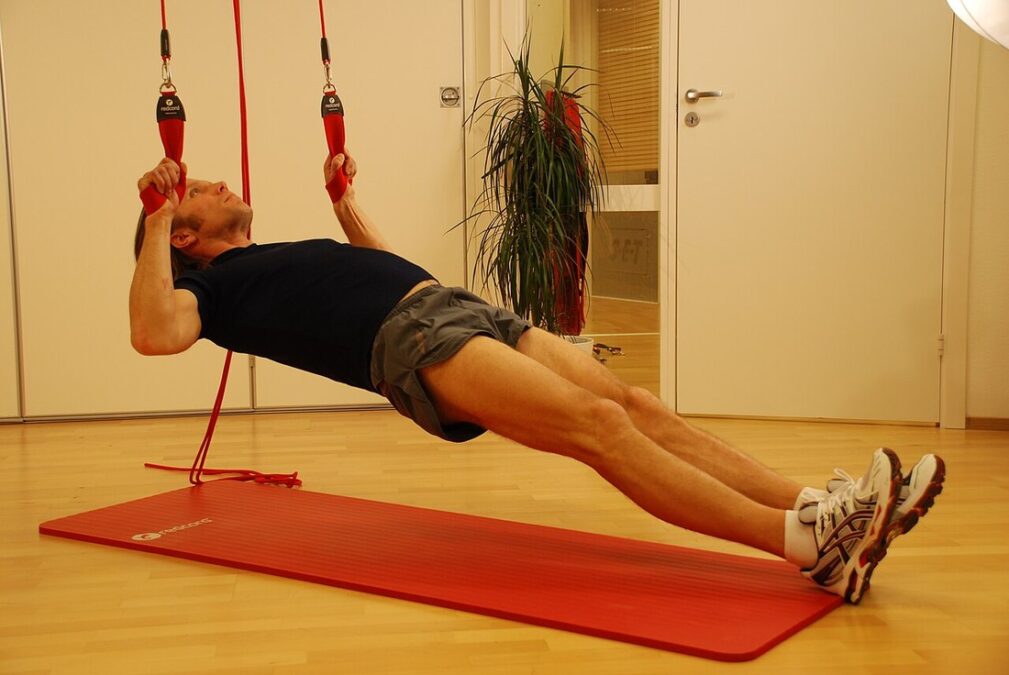
The second mistake is skipping the warm-up and the hip and core work. Push-ups alone will not balance a body that sits all day. Include squats, bridges, and core work in every session, and add a simple pulling movement — such as leaning back from a sturdy table edge or using a resistance band if you have one — once the basic routine feels comfortable.
The third mistake is training through sharp pain. Muscle burn and next-day soreness are normal. Sharp, stabbing, or joint pain, swelling, or pain that changes how you walk is not. Stop that exercise, rest, and seek advice if it persists. Finally, do not copy advanced routines from social media in week one. Single-arm push-ups and pistol squats are goals for later, not starting points.
Frequently Asked Questions
How long should a beginner bodyweight workout last?
About 20 to 35 minutes, including a five-minute warm-up, is plenty. Two or three sessions a week will produce results for most beginners. Longer is not automatically better; consistent, well-formed sessions are.
Can you build muscle with bodyweight exercises alone?
Yes, especially in the first year of training. Beginners can build visible muscle and substantial strength with bodyweight work alone, provided they progress to harder variations, eat enough protein (roughly 1.2 to 1.6 grams per kilogram of body weight per day is a common target for people building muscle), and recover between sessions. Very advanced athletes may eventually need external load for maximal strength, but that is a long way from a beginner routine.
How often should beginners do bodyweight training?
Three non-consecutive days a week is a strong starting point. That gives each muscle group about 48 hours to recover. Two days a week still works if your schedule is tight — it is far better than none, and you can add a third day later.
Do I need equipment for bodyweight exercises?
No. A mat, a sturdy chair, and a counter or wall are enough to start. A pull-up bar or a resistance band are useful additions later, particularly for pulling strength, but they are not required for the routine in this guide.
What should I do if an exercise hurts?
First, check your form and reduce the range or difficulty — for example, switch from floor push-ups to incline push-ups, or from full squats to chair squats. If pain is sharp, in a joint, or does not settle within a few days, stop that movement and get professional advice rather than pushing through it.
Conclusion: Start Small, Stay Consistent
You do not need a perfect routine, a home gym, or a dramatic overhaul of your life to get stronger. You need six good movements, three sessions a week, and the patience to repeat them for a couple of months. Start with the plan above, log your repetitions, and progress one small step at a time. In eight weeks, the squats that felt hard in week one will feel like a warm-up — and that is exactly how progress is supposed to feel.
Ready to begin? Put your mat out tonight, set aside 25 minutes tomorrow, and do your first session. Then come back in a week and tell yourself honestly what worked and what did not — and adjust from there.
Disclaimer: This article is for general wellness information only and is not medical advice. If you have a health condition, injury, or are new to exercise, talk to a qualified health professional before starting a new training programme.
