


A swimmer build is one of the most admired athletic physiques in sport. Broad shoulders, a wide V-shaped back tapering into a narrow waist, long powerful arms, and lean, athletic legs — you can often spot a competitive swimmer in a crowd without ever seeing them near a pool. It is a body shaped by thousands of hours moving through water, and it has become a fitness ideal for many people who want strength that looks as good as it performs.
But what exactly is a swimmer build? Which muscles create it, how does swimming sculpt it, and can you develop one yourself without training like an Olympian? In this guide, we break down the anatomy of the classic swimmer’s physique, explain how swimming builds it, and share practical training and nutrition guidance to help you work toward your own swimmer build.
What Does a Swimmer Build Look Like?
The classic swimmer build is defined by a handful of distinctive features. The most obvious is the V-taper: wide, rounded shoulders and a broad upper back that narrow dramatically toward the waist and hips. This shape comes from highly developed latissimus dorsi (the large “lat” muscles of the back) combined with a naturally lean midsection.
Swimmers also tend to have long, muscular arms with well-defined shoulders and triceps, a strong chest, and a tall, streamlined posture. Their legs are typically leaner than their upper bodies but still athletic, with strong glutes, quadriceps, and calves developed through powerful kicking. Overall body fat tends to be low, yet swimmers rarely look overly bulky — the water rewards a balance of strength and streamlining, so the result is a long, athletic frame rather than a heavy, blocky one.
It is worth noting that there is no single “correct” swimmer’s body. Sprinters may carry a little more muscle up top, distance swimmers may look leaner overall, and men and women share the same general proportions with differences in degree. What unites them is balance: a powerful upper body, a strong core, and an efficient, streamlined silhouette.
Key Muscles That Define a Swimmer’s Build
Every stroke in the pool is a full-body movement, but certain muscle groups do the heavy lifting and give the swimmer build its signature look. Understanding which muscles matter most helps you train with purpose, whether you are in the water or in the gym.
Upper Body: Lats, Shoulders and Chest
The latissimus dorsi are the stars of the swimmer’s physique. These broad muscles run from the lower back up to the upper arm, and every pull through the water — in freestyle, butterfly, backstroke, and breaststroke — loads them heavily. Well-developed lats create the wide back and V-taper that define a swimmer build.
The shoulders (deltoids) power the recovery phase of each stroke, lifting the arms out of the water and driving them forward again. The chest (pectorals) assists the pull, particularly in butterfly and breaststroke, while the triceps extend the arm to finish each stroke. Together, this upper-body development produces the broad, powerful shoulders swimmers are known for.
Core: The Engine of Every Stroke
A strong core is the hidden foundation of a swimmer build. The abdominals, obliques, and lower-back muscles keep the body in a straight, streamlined line in the water, transfer power between the upper and lower body, and drive the undulating motion of butterfly and the rotation of freestyle and backstroke. A swimmer’s midsection is typically lean and tightly toned rather than bulky — the result of thousands of stabilising contractions every session.
Legs and Glutes: Power for Kicks and Turns
While the swimmer build is famous for its upper body, the legs do essential work. The quadriceps, hamstrings, glutes, and calves power the flutter kick, the dolphin kick, and the explosive push-offs from every wall. Breaststroke adds an especially demanding frog kick that builds inner-thigh and glute strength. The result is lean, defined legs with genuine power rather than sheer size.
How Swimming Builds This Physique
Swimming shapes the body the way it does because water is roughly 800 times denser than air. Every movement meets constant resistance in all directions, so muscles work through a full range of motion on every stroke. Unlike many gym exercises that isolate a single muscle, swimming is inherently a full-body activity: the arms pull, the core stabilises, and the legs kick, all at once.
Volume matters too. Regular swimmers often train for an hour or more per session, repeating thousands of stroke cycles each week. This combination of resistance and repetition builds muscular endurance and definition, while the aerobic nature of the sport keeps body fat low. Different strokes emphasise different muscles — butterfly builds the chest and shoulders, backstroke works the lats and upper back, breaststroke targets the inner thighs and glutes — so varied training develops the balanced, symmetrical look of a true swimmer build. If you want to train each stroke correctly, our guide to swim stroke lessons walks you through all four competitive strokes step by step.
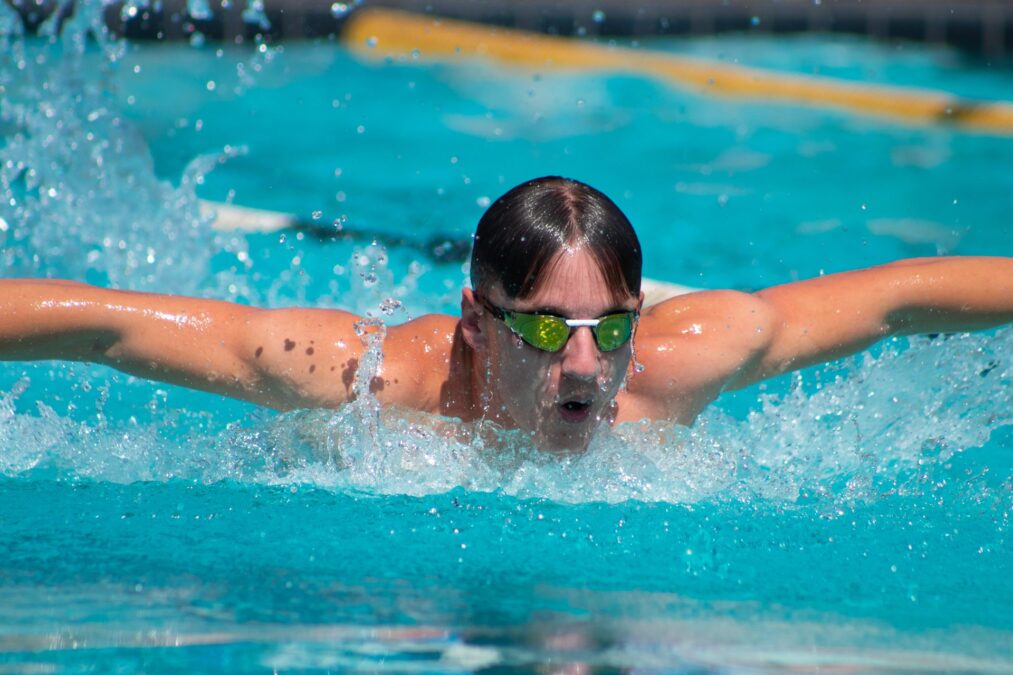
Because the water supports your body weight, swimming is also low-impact, which means you can train frequently with less joint stress than running or heavy lifting. That consistency — session after session, month after month — is the real secret behind the swimmer build.
Dryland Training: How to Build a Swimmer’s Body Out of the Pool
You do not need to live in the pool to build a swimmer-like physique. Dryland (out-of-water) training is how competitive swimmers add strength and power, and it works just as well for fitness swimmers. Focus on compound pulling movements that mimic the swimming stroke: pull-ups and lat pulldowns for the lats, bent-over rows for the upper back, and overhead presses for the shoulders.
Add push-ups or dips for the chest and triceps, planks and hanging leg raises for the core, and squats or lunges for leg power. Two to three dryland sessions per week is plenty alongside your pool time — keep the reps moderate (around 8 to 15) with good form, since swimmers need strength that lasts, not just one-repetition maximums. Always warm up thoroughly and progress gradually; quality technique in the gym, just like in the pool, is what keeps you training consistently.
Nutrition Basics for Swimmers
Building and maintaining a swimmer build takes fuel. Swimming burns a lot of energy — an hour of vigorous swimming can use several hundred calories — so under-eating is one of the most common mistakes. Base your meals around whole foods: lean proteins such as chicken, fish, eggs, and legumes to support muscle repair; complex carbohydrates such as oats, rice, and whole-grain bread to fuel long sessions; and plenty of fruit and vegetables for vitamins and minerals.
Try to eat a carbohydrate-rich meal or snack a couple of hours before training, and include protein with some carbohydrates within a couple of hours afterwards to aid recovery. Hydration matters too — you sweat in the pool even if you do not notice it, so drink water before, during, and after sessions. For more detailed guidance, USA Swimming, the sport’s national governing body, publishes nutrition resources for swimmers of all levels.
Swimmer Build FAQs
What is a swimmer build?
A swimmer build is an athletic body type characterised by broad shoulders, a wide V-shaped back, a narrow waist, long muscular arms, and lean athletic legs. It develops from the combination of full-body water resistance, high training volume, and the technique demands of competitive swimming strokes.
Does swimming build muscle?
Yes. Water provides constant resistance, so swimming builds lean, defined muscle — especially in the lats, shoulders, chest, core, and legs. It is particularly effective for muscular endurance and definition. For maximum muscle growth, many swimmers combine pool sessions with dryland strength training.
How long does it take to develop a swimmer build?
It depends on your starting point, training frequency, and consistency. Swimming two to four times per week with varied strokes, most people notice visible changes in shoulder and back definition within two to three months. The full, classic swimmer build typically develops over six months to a year of consistent training.
Can I get a swimmer build without swimming every day?
Absolutely. You do not need an Olympian’s schedule. Two to four quality pool sessions per week, combined with two dryland strength sessions and sensible nutrition, is enough to steadily build the swimmer’s physique. Consistency over months matters far more than daily marathon sessions.
Is a swimmer build achievable for women?
Yes. Female competitive swimmers display the same hallmarks — broad shoulders, a strong V-taper, and a lean, athletic frame — adapted to their own physiology. Swimming develops strength and definition for everyone, and the balanced, full-body nature of the sport makes it an excellent choice for women pursuing an athletic physique.
Conclusion
The swimmer build — broad shoulders, a powerful V-shaped back, a strong core, and lean athletic legs — is the natural result of moving through water with good technique, week after week. It is a physique built on endurance, balance, and consistency rather than short bursts of heavy lifting, which is exactly why so many people find it appealing.
If you want to work toward your own swimmer build, start where you are: swim two to three times a week, practise all four strokes to develop balanced muscles, add a couple of dryland strength sessions, and fuel your training with sensible nutrition. Be patient, stay consistent, and enjoy the process — the pool rewards everyone who keeps showing up.
Disclaimer: This article provides general fitness information only and is not professional medical advice. Please consult a qualified healthcare professional before starting a new exercise programme.
